


When a person participates in the Amazon’s vine program (Amazon Vine program) and becomes a “vine voice”, the reviewer receives products for free, but this does not mean that there are no tax considerations, according to amazon’s program the vine voices are responsible for the income tax on products they receive to review. The central word to this tax is ETV, which is Estimated Tax Value, the value on which the tax is supposed to be calculated on. Another change in 2026 has been the federal reporting standards, the threshold for certain information returns has been increased from $600 to $2000, which is not to be considered as a universal tax-free allowance.
In this guide, we will explain the amazon vine users about ETV, 1099- NEC reporting, the 2026 threshold change and the difference between reporting standards and the actual tax liabilities
Amazon vine taxes at a Glance
| Questions | Short answer |
|---|---|
| Are amazon vine products automatically tax free as they are provided for free to reviewers ? | No, they are not tax free |
| What does ETV mean ? | It means Estimated Tax Value, attached to a Vine item |
| Did the federal reporting threshold change in 2026 ? | Yes, it has now increased to $2000 from previously $600 for 2026 |
| Does $2000 threshold mean the products under $2000 are tax free | No it does not, $2000 threshold is a information reporting threshold not tax exemption threshold. |
| Does not receiving a 1099 form automatically mean that there is no tax liability? | No, it does not mean this. |
| Does every Vine reviewer has the same tax treatment ? | No the treatment could be different. |
Hence, from the above table it is clear that $2000 is information reporting threshold and not tax exemption blanket.
Do you pay taxes on Amazon Vine products ?
Amazon Vine program works differently than a Normal online Amazon Purchase, A vine Reviewer selects items from the eligible vine list of items and gets them for free, in return they give honest reviews of the product, however they are responsible for paying the income tax on the free products, and the tax is derived from Estimated Tax value which makes this value assigned as ETV valuable when it come to tax considerations.
These Vine items are valued at ETV and not the price which appears on the Amazon Product page, hence Vine voices should pay attention on the ETV of the items in vine records.
The main point is receiving something without paying cash for it, doesn’t make them irrelevant for tax considerations.
Also the treatment of individuals for tax consideration depends on the person’s circumstances, hence every vine reviewer may pay the same tax for same items.
What exactly is Amazon Vine ETV ?
According to Amazon’s Vine program ETV stands for Estimated Tax value, it is the value associated with the items of the vine program, the vine reviewers keep record of the items ETVs to track their yearly Vine activity. ETV is different than the item’s retail price which is displayed to normal buyers.
For Illustration, a products marketplace listing price can be different than the ETV of it in the vine records, which is why the vine reviewers rely on the items ETVs and keep yearly records of each items ETV and keep a yearly record of it.
For Example, record keeping can look like this:
| Date | Product | ETV | Order status | Adjustment/return note | Running total |
|---|---|---|---|---|---|
| Jan. 10 | Product 1 | $25 | Received | — | $25 |
| Jan. 18 | Product 2 | $40 | Received | — | $65 |
| Feb. 2 | Product 3 | $0 | Received | — | $65 |
This is not an IRS form, its just an example of vine tracking to understand vine activity to help for payment of taxes.
What changes have been brought to Amazon vine taxes in 2026 ?
The change has been brought to the reporting threshold, as for payments made before 2026 the reporting threshold was $600, now the IRS has changed that to $2000 for payments made in 2026, and for payments made after 2026, the inflation adjusted rules will apply.
Threshold comparison :
Before 2026 $600
2026 $2,000
After 2026 Subject to inflation-adjustment rules
Hence, here it is important to understand that $2000 threshold does not mean tax free.
As $ 2000 is information reporting standard for applicable payments on vine items and not Tax exemption threshold, which means it is not to be said that payments below $ 2000 are not to be paid income tax for. Hence reporting rules and taxability rules are different from each other.
Hence only follow official IRS information for reporting rules and not social media posts which are not accurate.
What is form 1099- NEC ?
Form 1099 – NEC is an IRS information return form, used for non employee compensation, Vine users may see this form while enquiring about amazon vine tax requirements, not every vine participant has to report in same way, The IRS provides information on who may need to file it. As a vine participant, Amazon may send you this tax form, review this form carefully and correlate with your own record keeping.
What if as a vine participant you don’t receive a 1099 -NEC form ?
It does not mean that not receiving 1099 form is equivalent to no tax issue, It could mean two things:
- Your reporting threshold might be lesser than $600 for payments before 2026, or lesser than $2000 for year 2026, or
- The value for returns to be made is unsure.
Hence it does not mean there is no tax issue.
Does $2000 threshold mean the vine products under $2000 are tax free ?
No, it does not mean this, $2000 is not a universal tax free threshold, this threshold is in reference to information reporting requirements, aa said by IRS in their official statement, hence if an article claims the opposite, do not consider that. Hence,
$2,000 reporting threshold ≠ $2,000 tax exemption.
Difference between Amazon Vine ETV and Retail price on Amazon platform
ETV stands for Estimated Tax value this is in reference to the Vine product value , and it may and may not be identical to the normal retail price of the product shown to normal shoppers. Hence for tax purposes vine participants refer to the ETV of the product and not the retail price displayed.
| Term | Meaning |
|---|---|
| ETV | Estimated tax value of a vine item |
| Retail price | Marketplace price of an item |
| Information reporting | Based on the relevant rules |
| Individual tax treatment | Applied on specific taxpayer’s circumstances |
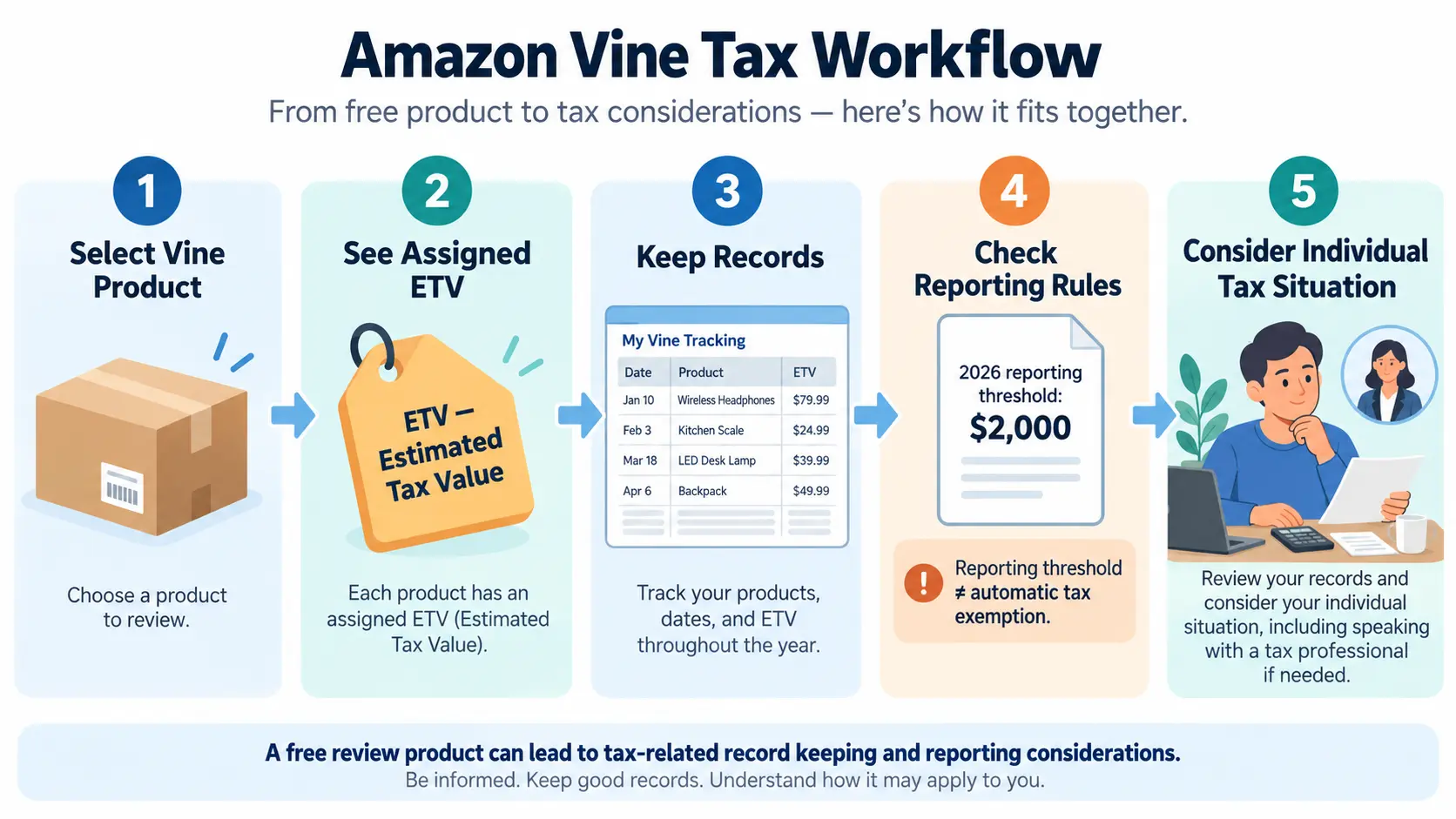
How can Vine participants track ETV of Vine products?
Vine participants should record their yearly product details in a simple running record for better organisation :
| Date | Product | ETV | Status | Notes |
|---|---|---|---|---|
| January 5 | Product 1 | $20 | Received | — |
| January 12 | Product 2 | $35 | Received | — |
| February 1 | Product 3 | $0 | Received | $0 ETV |
| February 10 | Product 4 | $75 | Received | — |
This isn’t an official IRS form, this is just an example of organisation.
As the tax treatment is specific to taxpayer’s circumstances, vine participants should also keep the following records:
- Information of Vine order
- ETV of every vine product
- Tax forms received from Amazon
- Return information
- Other records necessary for own tax payment. The aim is have records and not solely rely on memory.
Amazon vine Hobby Vs Business Vs self Employment: Vine participant classified under which?
Amazon Vine vs Amazon Influencer Program
When it comes to tax paying, the confusion lies in classifying the vine participants, whether their participation is just a hobby, a business or self employment tool. There is no distinction of every participant in any one category.
Hence taxing depends on actual facts and circumstances of the taxpayer. For example, following questions help:
- If the participant is a regular vine voice ?
- If the motive is profit making ?
- If the person already as a business ?
- Are the products resold ?
- Is any extra service provided ?
- Look at the overall activity of the vine participant.
Hence a participant who regularly receives product is different than a person who carries on a larger front from reviewing to content creation to other services. Hence to classify oneself refer to IRS guidance or a qualified U.S. tax professional.
Common Amazon Vine Tax mistakes
1. To consider free products as tax free
This is a normal confusion, that cash free product means no tax responsibility, but income tax on the product is vine participant’s responsibility, even clarified by Amazon.
2. Treating $2000 as tax exemption blanket
This amount relates to information furnishing threshold by IRS , and is not related to tax compliance.
3. Considering ETV as product’s retail price
Both are different and may or may not be same, ETV is associated with vine program selected products.
4. Ignoring records until tax time
Common mistake to reply on memory, rather vine participants should take regular records.
5. Assuming that not receiving 1099 form means no tax
Common mistake, this does not mean no tax issue, read guidelines of IRS for further clarification.
6. Using the old $600 threshold in 2026
This threshold has been revised to $2000 for information compliance to IRS for year 2026.
7. Considering Reddit as the information platform
Not to consider the information furnished on social media as the truth, refer official sources.
8. Considering every vine participant’s tax situation is same
It depends on individual circumstances hence tax advise is different for all participants.
What sources should vine participants trust ? In the following sequence:
- IRS- use IRS’s website for information and tax compliance rules like form 1099 guidelines, IRS regular publications and return guidance.
- Amazon- as this a Amazon program, refer their documentation on the Vine program to get all answers.
- Qualified U.S. tax professional- to get clarity on individual’s income, business model, deductions etc
- Community discussions
On platforms like reddit to get answers to basic questions, this is not an substitute to official source like IRS.
Amazon wine taxes: simplified
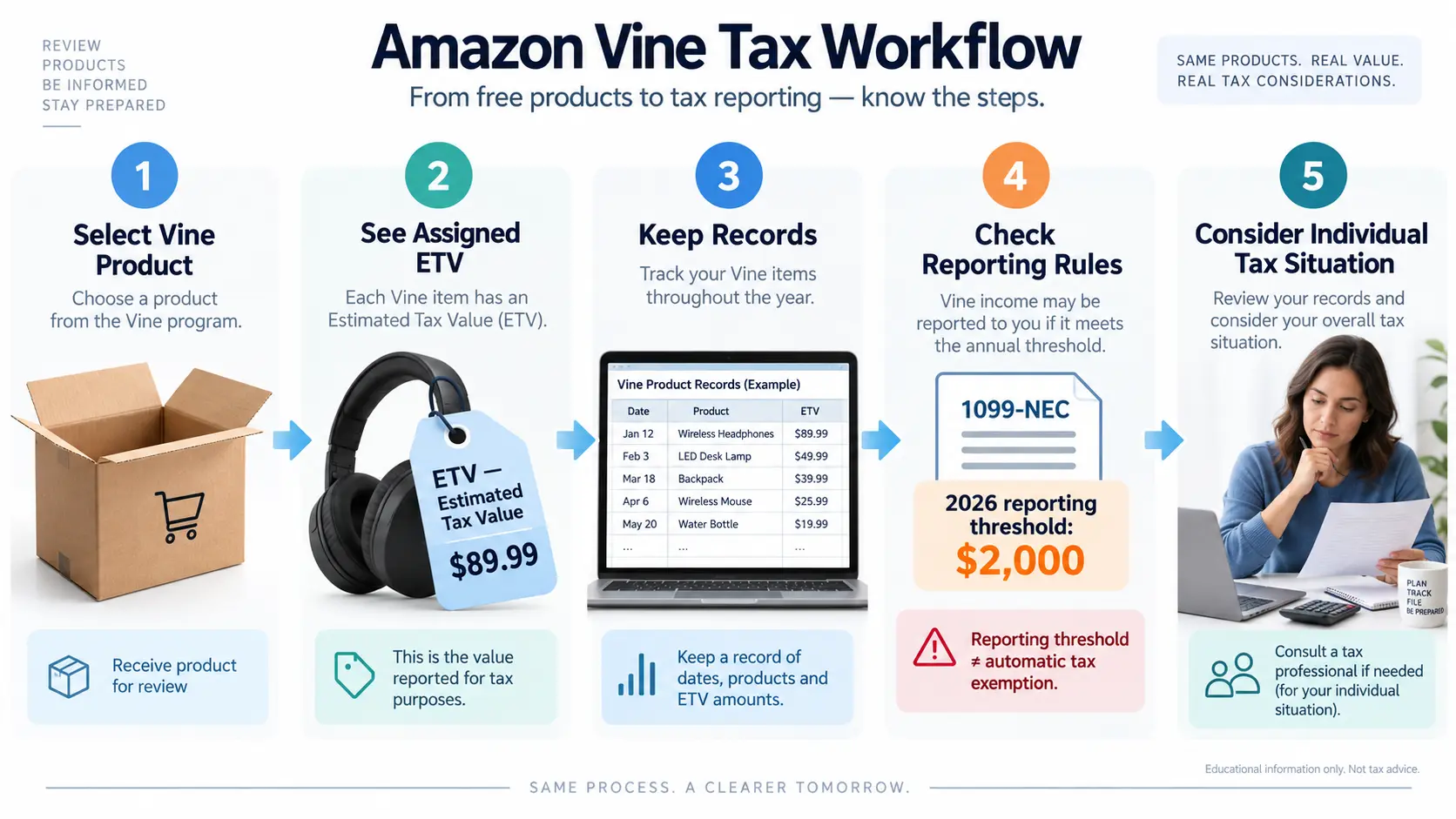
Select Vine product
↓
See Amazon-assigned ETV
↓
Keep records of these products
↓
See applicable information-reporting rules
↓
Consider individual tax situation
This is way more simplified way, than thinking “ I got a free product, hence no tax to be paid; If my purchase is below $2000, no tax is to be paid “
Frequently asked questions :
Are Amazon vine products taxable ?
Yes, According to Amazon Vine program , the income tax responsibility lies on the vine participant.
What is Amazon vine ETV ?
It means Estimated Tax Values, it is the value associated with the vine selected product, it is used to calculate the tax on the vine product
What is Amazon Vine 1099 – NEC threshold for 2026 ?
According to IRS, the threshold has changed to $2000 above which the information compliance is to be dome.
Did the reporting threshold change from $600 to $ 2000 ?
Yes the threshold has changed for year 2026 which is $2000, for payments before 2026 it is $600.
Does the threshold $2000 mean the vine products under this threshold are tax free ?
No, this is wrong, as this threshold is for information reporting and not for tax paying.
What if I do not receive the 1099-NEC form from Amazon ?
It does not necessarily mean that there is no tax situation, refer to IRS guidelines for further query.
Is the AmAzon Vine ETV same as the product’s retail price ?
It may and may not, ETV is different to the retail price, hence it may be same, may not be same.
Is Amazon vine hobby income or self employment income?
There is no specific answer to this question, it varies from participant to participant, It depends on the overall activity of the vine participant, if the participant is full time vine reviewer or has other income sources.
How should Amazon Vine reviewers keep track of ETV.
The vine participants should keep a regular record keeping of each payment made, status of vine order, date, product name etc, organise well and use it when tax compliance is to be done.
It is natural for Vine participants to get overwhelmed as there are several terms like information reporting, Form 1099 – NEC, and individual tax treatment. For year 2026 the only change is the federal information reporting standard by the IRS , the payment threshold is revised to $2000 from $600, which is not a threshold for tax treatment. The first step is to understand the difference between information reporting and taxability, second step is to keep records for accurate tax treatment, lastly use trustworthy sources like IRS website and Amazon’s Vine documentation, to get answers to the queries and seek professional advise if individual circumstances need accurate and personal solutions.


