


If you’re reading biographies or net worth articles, you’ll see four terms used constantly: net worth, income, salary, and revenue. Many pages treat them like the same thing. They aren’t. Confusing them is one of the fastest ways to believe a misleading number.
This guide breaks each term down clearly, shows how they connect, and explains the common errors that cause inflated “net worth” claims.
For the full calculation method, read: How Net Worth Is Calculated.
Net worth vs income: the answer in 60 seconds
Income is money flowing in over time, per month or per year. Net worth is a snapshot on a specific date: what you own minus what you owe.
Here’s the simplest way to remember it:
- Income = flow (what comes in during a period)
- Net worth = stock (your financial position at a point in time)
A quick example: In 2026, Alex earns $90,000 in income, but Alex’s net worth is only $25,000 because savings and investments are still small, and debts (student loans + a car loan) are still large.
Income alone can be misleading. You can earn a lot and still have low (or even negative net worth if you carry big debts or spend most of what you make. This article also clarifies salary and revenue, because many net worth pages mix these up or use them interchangeably—especially in celebrity and business profiles.
Later sections include typical benchmarks by age and practical steps you can use to calculate and improve your net worth.
Key definitions: income, salary, revenue, and net worth
These four terms get confused constantly. Use this mini reference guide.
Income (personal)
Income is all the money you receive over a period of time—monthly or yearly. It can include wages, bonuses, business profits, side hustles, royalties, dividends, rental income, and sponsorships. Your annual income determines your capacity to cover living expenses, save, and invest.
Salary (a type of income)
Salary is a fixed amount paid by an employer, usually stated annually (for example, $80,000 per year paid biweekly). Salary is just one type of income. Many people in the same industry earn similar salaries, but their net worth can vary wildly based on spending and saving habits.
Revenue (business)
Revenue is a business number: total sales before expenses. Revenue refers to the top line on a company’s income statement. Example: an online store does $1.2 million in revenue in 2025. That is not the owner’s income and definitely not the owner’s net worth. A company’s revenue only tells you about sales volume—not a company’s profitability.
Net worth (personal wealth snapshot)
Net worth = total assets − total liabilities.
Example: If you own $40,000 in assets (cash + investments) and owe $15,000 (loans/credit), your net worth is $25,000.
Flow vs stock comparison: Income/salary/revenue are flows measured over time; net worth is a stock measured at a point in time. Net worth measures what you’ve accumulated, not what you earn.
What is income? (And what actually counts as income)
Income is a recurring flow that pays for your bills, savings, and investments. It’s measured over time—like “per month” or “per year.” Understanding your income level is the starting point for any personal finance plan.
Gross income vs net income (take-home pay)
- Gross income is what you earn before taxes and deductions
- Net income (take-home pay) is what lands in your account after taxes, benefits, and other deductions
To calculate net income, subtract all deductions from gross pay. Here’s a simple example for a pay period in May 2026:
Line Item | Amount |
|---|---|
Gross pay | $7,500 |
Taxes withheld | $1,650 |
401(k) contribution | $450 |
Health insurance | $250 |
Net pay | $5,150 |
The difference between gross and net income matters because gross income overstates what you actually have available to spend, save, or invest.
Common income sources (real examples)
Income can come from:
- wages, salary, overtime, tips
- freelance invoices and consulting payments
- business profits after expenses (revenue minus expenses, not gross sales)
- rent checks (rental income)
- dividends and interest from an investment account
- YouTube ad revenue, affiliate commissions, subscriptions, memberships (Patreon-style models)
Important: business revenue is not the same as personal income. The owner’s income is what they pay themselves from profit (what’s left after costs, taxes, and reinvestment). Both revenue and profit matter for a business, but only profit can become personal income.
Income can also arrive in bursts:
- a $15,000 bonus at year-end 2025
- a one-time contract payout
- a seasonal sales spike
Those bursts can accelerate net worth—if they’re handled intentionally instead of disappearing into spending. Earning income is one thing; converting it to assets is another.
What is salary? (A specific type of income)
Salary is a predetermined yearly amount paid by an employer (for example, $120,000 per year in 2026), typically paid out in equal installments.
Salary often comes with other compensation elements:
- bonuses
- stock options or equity grants
- benefits (health insurance, retirement match)
Those extras can influence financial stability, but they are not automatically net worth. Salary becomes net worth only when part of it is converted into assets (savings, investments, equity) or used to reduce liabilities (paying down debt).
A direct reminder that clears up 90% of confusion:
A $120,000 salary is not the same thing as a $120,000 net worth.
Someone with a high income can have modest net worth if spending rises with each raise. Career development and salary growth matter, but only if the additional total money coming in gets converted to lasting assets.
What is revenue? (Why big sales numbers don’t equal big wealth)
Revenue is a business metric, not a personal wealth metric.
Revenue is the total money a business takes in from sales and services before subtracting:
- refunds
- advertising
- payroll
- rent
- software/tools
- shipping and fees
- taxes
Sales revenue appears on the top line of a company’s income statement. Net revenue is what remains after returns and allowances. But neither figure tells you what the owner actually earns or owns.
A concrete example: In 2025, a creator’s company sells $2,000,000 in courses and merchandise. But operating expenses are real:
Cost Category | Amount |
|---|---|
Ad spend | $800,000 |
Team salaries | $350,000 |
Platform fees | $150,000 |
Refunds | $100,000 |
Total costs | $1,400,000 |
Profit remaining | $300,000 |
Only profit can become the owner’s income. Net profit (also called net earnings) is what’s left after all operating income deductions. And only what the owner keeps (after taxes and personal spending) can build net worth.
This is why many “net worth” pages get it wrong: they grab a huge revenue number (or a contract headline) and treat it as personal wealth. That’s one of the biggest red flags in celebrity net worth content. Gross profit and operating income get confused with owner wealth constantly.
What is net worth? (Your real wealth after debts)
Net worth is the cleanest snapshot of financial position on a specific date (for example, December 31, 2025). It represents your overall financial health at that moment.
Net worth = assets minus liabilities
Assets (things you own with value)
Examples:
- cash, savings
- brokerage and retirement accounts
- home equity (the total value minus mortgage balance)
- vehicles (resale value)
- ownership stakes (equity in a small business)
- valuable collectibles (conservatively estimated)
All your assets combined give you one side of the equation.
Liabilities (what you owe)
Examples:
- mortgage balance
- student loans
- car loans
- personal loans
- credit card balances (especially credit card debt with high interest)
- tax bills
- unpaid invoices
High interest debt like credit cards can erode net worth quickly if balances grow.
Worked example (realistic, step-by-step)
A 35-year-old in 2026 has:
Asset | Value |
|---|---|
Checking/savings | $18,000 |
401(k) | $62,000 |
Brokerage | $24,000 |
Condo market value | $320,000 |
Car resale value | $12,000 |
Total assets | $436,000 |
Liability | Balance |
|---|---|
Mortgage balance | $255,000 |
Student loans | $14,000 |
Car loan | $6,000 |
Credit card balance | $3,000 |
Total liabilities | $278,000 |
Net worth = $436,000 − $278,000 = $158,000
This person has a positive net worth of $158,000.
Net worth can be negative (and that’s common early)
A 24-year-old in 2026 might have:
- $5,000 savings
- $35,000 student loans
Net worth = −$30,000
Negative net worth early in a career is common. Net worth tends to change over time as savings accumulate, investments grow, properties appreciate, and debts are paid down (or taken on). Unexpected expenses or major purchases can also shift the number temporarily.
Net worth vs income: how they interact
Income is the fuel. Net worth is what’s built over time from that fuel. Both income and net worth matter, but they move independently in the short term.
Example 1: High salary, low net worth (lifestyle inflation)
In 2026, Jordan earns $180,000 salary but has:
- high rent and high monthly spending
- credit card balances
- a large auto loan
Jordan’s net worth stays close to $0 because very little surplus is converted into assets and debt stays high. A high income doesn’t guarantee financial success.
Example 2: Modest income, high net worth (disciplined investing)
Taylor earns a more modest income but has invested consistently since 2012, keeps spending stable, and avoids high interest debt. Retirement accounts have grown, and a paid-off car reduces liabilities. Over time, assets compound and net worth becomes high even without an extreme salary.
The average net worth for someone in Taylor’s position often exceeds peers with the same income but different habits.
Example 3: Irregular income, eventually strong net worth (freelancer pattern)
Morgan’s income swings in 2024–2026. Once expenses stabilize and Morgan builds a buffer, surplus income flows into debt payoff and investing. Net worth rises after consistency—not just after a single big year.
A simple math view over 5–10 years:
- Net worth rises when surplus income is consistently directed to asset building and liability reduction
- Investment returns can grow net worth even if income stays flat (compounding works over time, but returns vary year to year)
Major life events can cause sudden changes independent of day-to-day income:
- home purchase (liabilities rise, assets also rise)
- job loss (income drops)
- inheritance (assets jump)
- major medical or legal costs (liabilities rise)
These events affect your financial life in ways that regular income patterns don’t predict.
Read: Why Net Worth Estimates Differ Across Websites
Common misconceptions: why so many “net worth” numbers are wrong
Celebrity and influencer net worth estimates often rely on guesswork and incorrect concepts. The most common errors include:
- Treating annual salary as net worth
- multiplying one year’s income by someone’s age
- using business revenue as “proof” of personal wealth
- ignoring taxes, agent fees, and expenses
- counting brand value or fame as an asset
- ignoring liabilities (mortgages, divorces, lawsuits, back taxes)
Example scenario: An athlete signs a $20M contract in 2024. Some pages claim the athlete has a $20M net worth. But taxes, agent fees, interest payments on loans, and living costs reduce how much actually becomes savings or assets—and debt may still exist.
A clean calculation requires asset values and debt balances at a point in time, which are rarely fully visible for public figures. Even a company’s ability to generate sales doesn’t tell you what the owner personally keeps.
The safest way to read published net worth figures: treat them as estimates unless backed by disclosures, filings, or transparent methodology. The key differences between income, revenue, and net worth get blurred constantly in online content.
How to calculate your own net worth (step-by-step)
This is educational information, not individualized financial advice. The goal is clarity. Financial experts generally recommend calculating net worth at least once per year.
Step 1: List financial assets with current balances (use the same date across accounts):
- checking, savings
- brokerage
- retirement accounts (401(k), IRA)
Step 2: List non-financial assets with reasonable market values:
- home value (estimate based on comparable sales)
- car resale value
- other valuables (conservative estimates only)
Step 3: List all debts using statement balances:
- mortgage
- student loans
- car loans
- credit cards
- personal loans
Step 4: Add up total assets and total liabilities.
Step 5: Subtract: net worth = assets − liabilities
If you want a practical breakdown of what counts on each side, use our Assets vs Liabilities: The Net Worth Checklist That Actually Works before estimating any net worth number.
Use a consistent “snapshot” date (example: March 31, 2026) so your numbers are comparable over time. You can calculate your net worth quarterly or annually to track your financial future.
For harder-to-value items (private business shares, startups, art), be conservative. Overestimating illiquid assets is the easiest way to fool yourself (and it’s the same reason online net worth pages are often inflated). The total value of these items should reflect what you could realistically sell them for.
Benchmarks: how income and net worth typically compare by age
Benchmarks are averages and medians. They vary heavily by location, household structure, education, and career path. Use them as context—not as a scorecard.
One reliable way to view benchmarks is the Federal Reserve’s Survey of Consumer Finances (SCF), which reports net worth and income statistics by age group.
Here are median household net worth figures by age (SCF-based summaries commonly reproduced by major financial publishers):
Age Group | Median Net Worth |
|---|---|
Under 35 | $39,000 |
35–44 | $135,600 |
45–54 | $247,200 |
55–64 | $364,500 |
65–74 | $409,900 |
75+ | $335,600 |
Average net worth figures are higher than medians because a small number of very wealthy households pull the average up.
Income also varies by age group in SCF reporting. The key point is not comparing yourself to a national median or average price of success, but tracking your own trend over 3–5 years and understanding whether your net worth is moving in the right direction.
By retirement age, financial well being often depends more on accumulated net worth than on income, since many people stop earning income or earn less.
How to improve your income (without turning it into lifestyle inflation)
Higher income can speed up creating wealth—if spending doesn’t rise at the same pace.
Practical, general strategies:
- build skills that increase your market value (training, certifications, portfolio proof)
- negotiate compensation where appropriate
- consider role changes when growth is capped
- add a side income stream that fits your time and skills (freelancing, consulting, small digital products)
Some people generate sales through side businesses. Others focus on core business activities at their employer to earn more money through promotions. Both paths can work.
The key link to net worth is simple: extra income works best when it’s assigned in advance to debt payoff, savings, and investing—rather than absorbed by spending. Units sold in a side business or market share gained at work only matter if the money generated converts to assets.
Each pay stub represents an opportunity—not a guarantee of wealth.
How to improve your net worth (two levers)
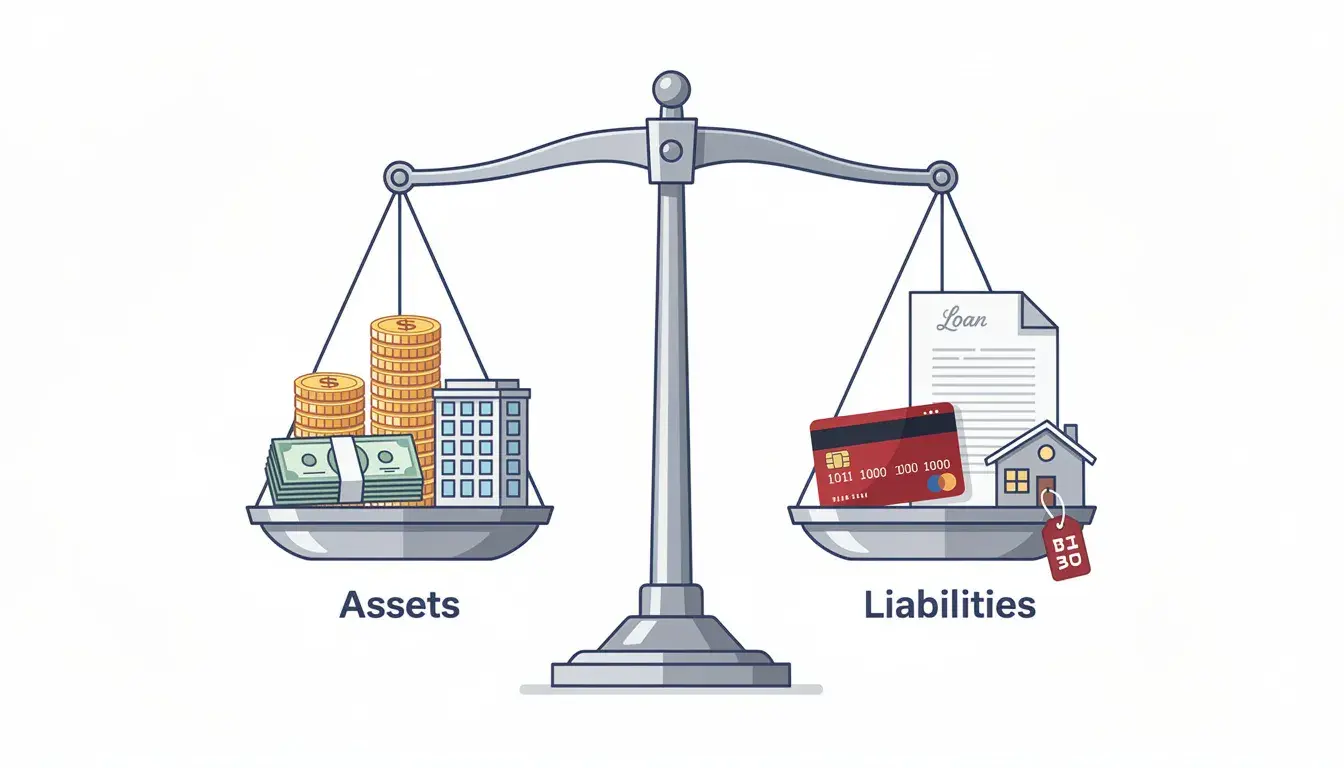
Net worth improves through two levers:
- Increase assets (savings, investing, equity building)
- Reduce liabilities (debt payoff, avoiding high-interest balances)
General, safer habits that support both:
- track net worth quarterly (same method each time)
- build an emergency buffer to avoid high-interest debt during surprises
- prioritize paying down high-interest balances first
- invest consistently over long horizons (returns vary, but consistency matters)
- set financial goals with specific targets
Money generated through income becomes net worth only when it’s converted to assets or used to reduce debt. Free money doesn’t exist—every dollar either gets spent or saved.
Your financial position improves when assets grow faster than liabilities. That’s how you improve your net worth over time.
Which matters more: net worth, income, salary, or revenue?
All four metrics matter, but they serve different purposes:
- Income (including salary) supports day-to-day financial stability and funding goals
- Net worth is the long-term scorecard of how much income you converted into lasting assets after decades of earning and spending
- Revenue matters for understanding a business (calculate revenue to track growth), but only indirectly matters for personal wealth because only profit and what the owner keeps can build net worth
Income vs net worth isn’t about choosing one. It’s about understanding how they connect.
If you track only one number, net worth is the cleanest long-term snapshot of financial success. If you track two, track income and net worth together. That combination tells you both your current capacity and your accumulated progress.
Investopedia — Net worth definition (assets minus liabilities): https://www.investopedia.com/terms/n/networth.asp
Investopedia — Revenue vs income (why revenue isn’t profit/income): https://www.investopedia.com/ask/answers/122214/what-difference-between-revenue-and-income.asp
Federal Reserve — Survey of Consumer Finances (SCF) overview: https://www.federalreserve.gov/econres/scfindex.htm
Federal Reserve — SCF data visualization table (1989–2022): https://www.federalreserve.gov/econres/scf/dataviz/scf/table/
Fidelity — Median household net worth by age (SCF-based summary): https://www.fidelity.com/learning-center/smart-money/average-net-worth-by-age


