


Quick answer: Amazon Vine has two reviewer tiers. Silver is the entry level — up to 3 item requests per day with a $100 value cap per item. Gold is the advanced level — up to 8 items per day with no value cap and access to a wider product catalog. Reviewers start in Silver and earn Gold by reviewing 80 or more items with a 90% completion rate inside Amazon's evaluation window.
In short: Silver is where every Vine Voice begins. Gold is where high-performing reviewers move once they prove they can keep up with the program's review obligations. The two tiers differ in three measurable ways: how many items you can claim each day, how expensive those items can be, and which product categories appear in your dashboard.
What Amazon Vine reviewer tiers are
When Amazon invites a reviewer into the Vine program, the account is automatically placed in the Silver tier. As the reviewer accumulates completed reviews and maintains their completion rate, Amazon evaluates the account at fixed intervals and may promote it to the Gold tier.
Both tiers operate inside the same Vine dashboard at vine.amazon.com. The difference is not the interface but the access — Gold unlocks higher request limits, removes the per-item value cap, and surfaces higher-value inventory that Silver members cannot see. For a walkthrough of the dashboard itself and how reviewers sign in, see the Amazon Vine portal access guide
Tier status is not permanent. A reviewer who fails to meet maintenance requirements can be moved back to Silver or have the account closed entirely.
Amazon Vine Silver vs Gold at a glance
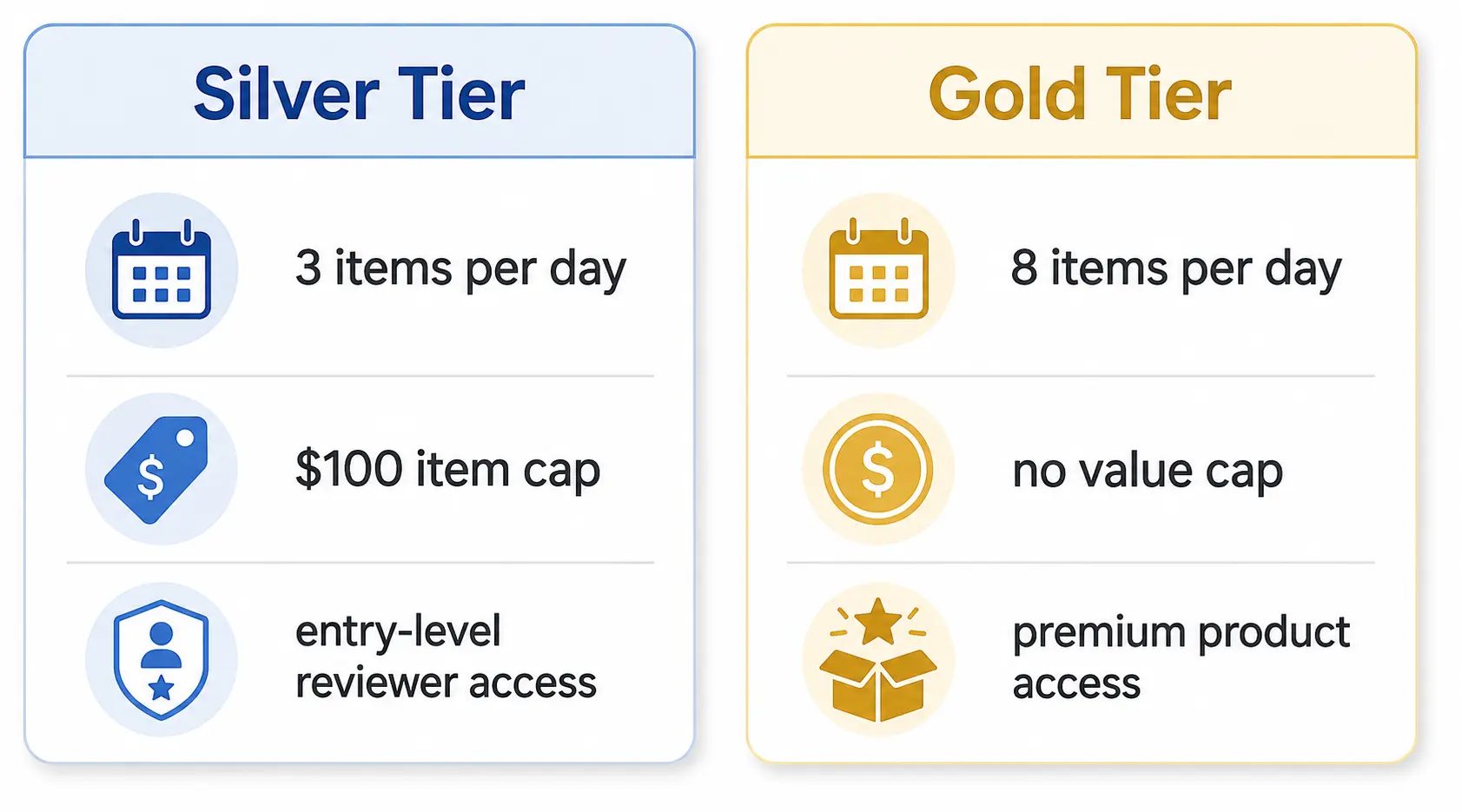
| Feature | Silver tier | Gold tier |
|---|---|---|
| Daily request limit | Up to 3 items | Up to 8 items |
| Item value cap | $100 per item | No cap |
| Product categories | Standard inventory | Standard + premium categories |
| Required for promotion | — | 80+ reviewed items, 90% completion in evaluation window |
| Maintenance rule | Keep 60%+ completion rate | Keep 90%+ completion rate |
| Account type at invitation | Default starting tier | Earned by performance |
What the Silver tier offers
Silver is the working entry point for every new Vine Voice. The structure is designed to let reviewers build a track record without overwhelming them, and to protect Amazon from inviting reviewers who cannot keep up with the review obligation.
Daily access. Silver members can request up to three items per day. Items reset on a rolling 24-hour basis, not at midnight, so claiming three items at 9 a.m. means the next request slot opens at 9 a.m. the following day.
Value cap. Each item must be priced at $100 or less at the time of request (around £82 in the UK marketplace, with similar local caps in other Vine countries). High-value items — large electronics, premium kitchen appliances, premium tools — are filtered out of the Silver feed entirely.
Inventory scope. The Silver dashboard shows a broad but standard inventory: home goods, kitchen items, mid-range electronics, personal care, books, hobby gear, and similar consumer categories. Higher-ticket inventory is held back for Gold.
Maintenance threshold. Silver members must keep their completion rate above 60% — the percentage of received items that have been reviewed within Amazon's 30-day window. Falling below 60% can trigger an account review or closure.
Silver is also where most reviewers stay. Only a portion of Vine Voices ever meet the Gold promotion criteria, and Amazon has not published the proportion publicly.
What the Gold tier offers
Gold is the advanced tier for reviewers who have demonstrated they can review at volume without missing deadlines.
Daily access. Gold members can request up to eight items per day — more than double the Silver allowance. For active reviewers, this is the practical ceiling on how many products they can realistically test and review per month.
No value cap. The $100 per-item limit is removed. Gold reviewers can request products of any price, which opens the door to large appliances, premium electronics, designer goods, and other high-ticket categories that simply do not appear in the Silver feed.
Expanded inventory. Gold-only product categories are unlocked. These vary by marketplace but typically include premium electronics, larger home appliances, professional tools, and a wider selection of brand-restricted items that sellers reserve for higher-tier reviewers.
Higher maintenance threshold. Gold members must keep their completion rate at 90% or above inside the evaluation window. The bar is much stricter than Silver, and falling below it can trigger demotion back to Silver rather than outright closure.
The Gold tier is not a permanent status. Each evaluation cycle resets the count, and a reviewer can drop back to Silver in any cycle where the 90% completion rate is missed.
How to get promoted from Silver to Gold
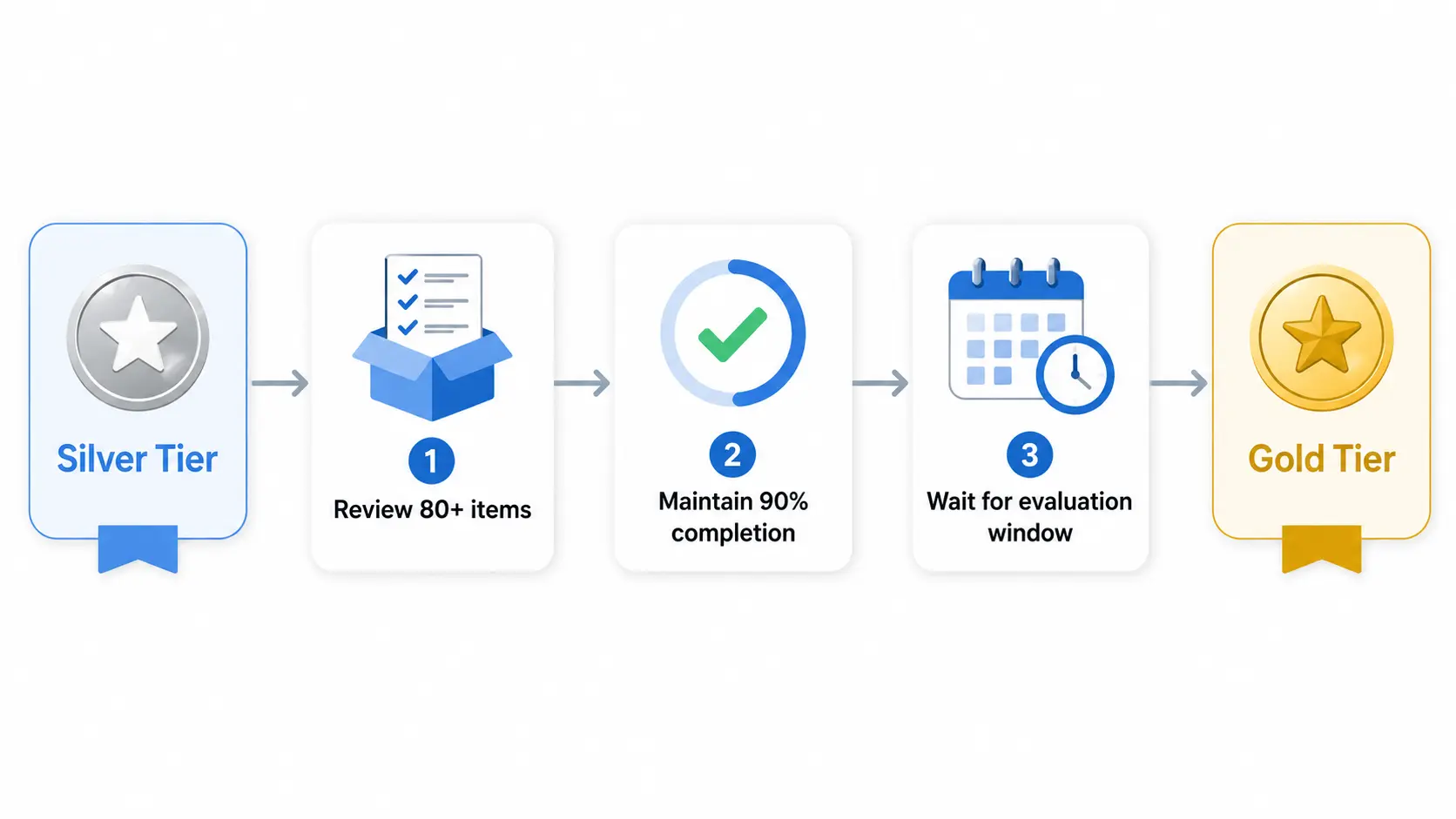
Amazon evaluates Vine Voice accounts on a recurring schedule. To move from Silver to Gold, an account generally needs to meet two thresholds within the same evaluation window:
- Review at least 80 Vine items. This is the minimum volume Amazon uses to assess consistency. The exact figure may shift between marketplaces, but 80 reviewed items inside a six-month window is the threshold most reviewers report.
- Maintain a completion rate of 90% or higher. Out of every 100 items received, at least 90 must be reviewed within the 30-day deadline.
A reviewer who hits both thresholds at the end of an evaluation period is automatically promoted. There is no application, no appeal, and no way to accelerate the timeline beyond completing reviews well and on time. The promotion appears as a status change inside the Vine dashboard, usually accompanied by an email notification.
What helps in the months leading up to promotion is a steady cadence rather than bursts. A reviewer who claims and reviews two items per day every day will hit 80 items in about 40 days; the discipline is in keeping the 90% rate intact across the full window, not in claiming faster.
For a sense of how reviewers reach the program in the first place — well before tier considerations — our breakdown of what triggers a Vine invitation covers the selection signals Amazon uses.
What happens if you fall behind in either tier
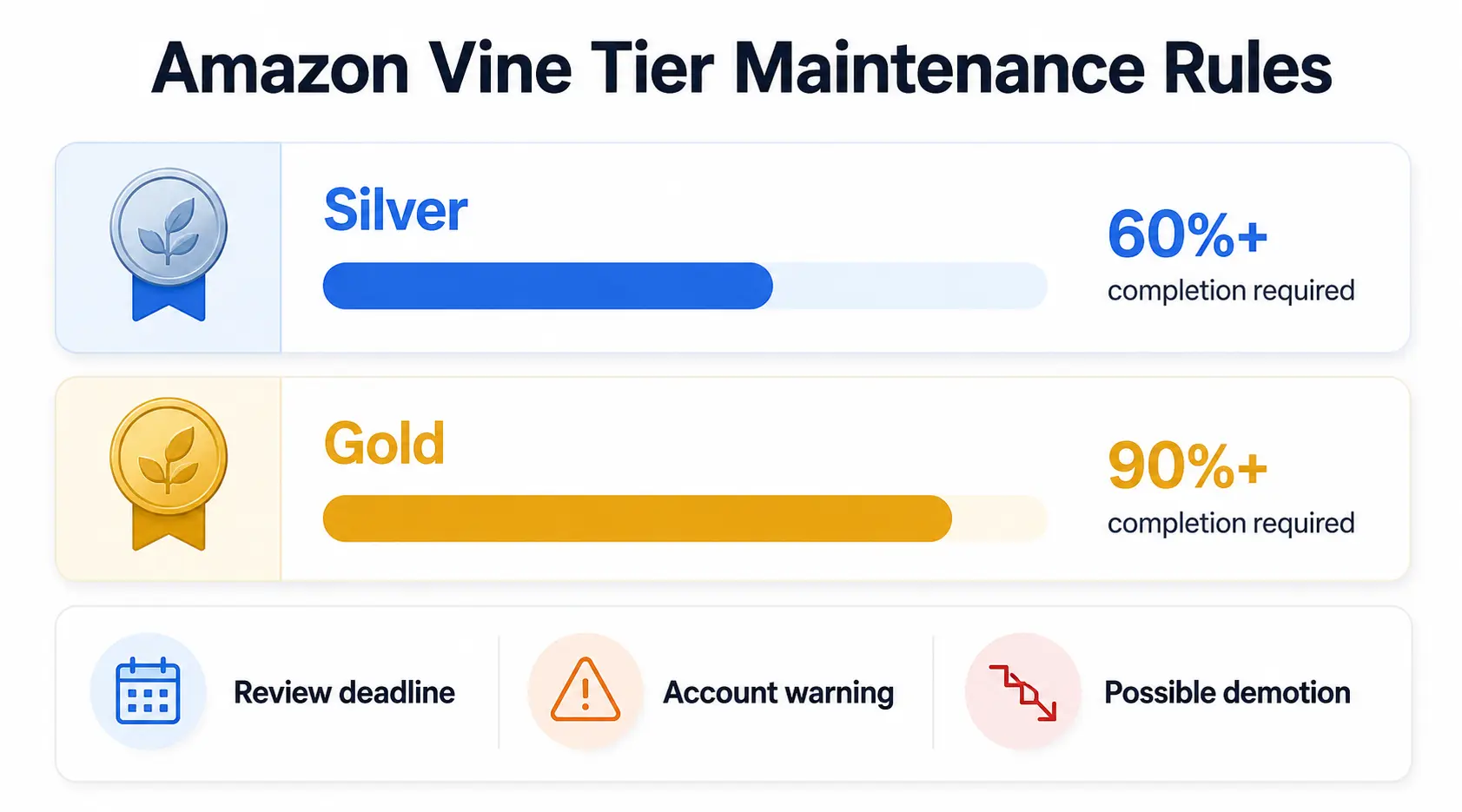
Both tiers have maintenance rules, and missing them has different consequences depending on which tier you are in.
In Silver: Falling below the 60% completion rate places the account under review. The Vine dashboard displays a warning, and continued underperformance can result in account closure. Closure is final — Amazon's Vine team has confirmed that closure decisions cannot be reversed by customer service.
In Gold: Falling below the 90% completion rate during an evaluation window typically demotes the account back to Silver rather than closing it. The reviewer keeps program access but loses the higher daily limit, value cap removal, and premium inventory. Demoted reviewers can re-qualify for Gold in a later evaluation window by meeting the thresholds again.
In both tiers, the most common cause of falling behind is overclaiming — requesting more items than the reviewer has time to actually use and write about. The safer pattern is to claim only what fits the reviewer's actual capacity, even if more items are available.
Why the Gold tier matters for serious reviewers
For reviewers who treat Vine as a meaningful side activity, the practical difference between Silver and Gold is significant in three ways.
First, the catalog depth. Many of the products experienced reviewers want to test — robot vacuums, larger appliances, mid-priced electronics — sit above the $100 Silver cap. Gold is the only way into that inventory.
Second, the request volume. Eight items per day are enough to meaningfully shape monthly review output. For reviewers who publish frequently or cover specific categories in depth, Gold provides the inventory access to sustain that.
Third, the tax and obligation picture changes. Higher-value items mean a higher estimated taxable value on the year-end form Amazon issues in the U.S. once the IRS reporting threshold is reached. Reviewers moving up to Gold should plan for the tax implications, not just the access benefit.
Silver is enough for most Vine Voices, and there is no penalty for staying there. Gold is worth pursuing only if the reviewer has the time and discipline to maintain the 90% completion rate consistently.
Frequently asked questions
Is Amazon Vine Gold better than Silver?
Gold offers more daily requests (8 vs 3), no per-item value cap, and access to premium product categories. Whether it is better depends on the reviewer's capacity to maintain the stricter 90% completion rate.
How long does it take to reach the Gold tier?
Most reviewers who qualify reach Gold in one full evaluation window — typically six months from invitation — by reviewing 80 or more items with a 90% completion rate.
Can you skip Silver and start directly in Gold?
No. Every new Vine Voice begins in Silver. Gold is earned by performance inside the program, not assigned at invitation.
What is the Amazon Vine Gold tier value cap?
There is no cap on the value of Gold. Reviewers can request items at any price, including high-ticket products that are not visible in the Silver feed.
Can a Gold-tier reviewer be demoted to Silver?
Yes. If a Gold reviewer's completion rate falls below 90% during an evaluation window, the account is moved back to Silver. The reviewer can re-qualify for Gold in a later cycle.
Does Amazon Vine Silver have a daily request limit?
Yes. Silver members can request up to three items per day, with a $100 per-item value cap.
Are Gold-tier reviewers paid more than Silver-tier reviewers?
No. Neither tier pays reviewers cash. Both receive free products in exchange for honest reviews, and U.S. reviewers may receive a tax form for the estimated value of items received in a year once the IRS threshold is reached.
Can you see which tier you are in on the Vine dashboard?
Yes. Tier status is displayed inside the reviewer's Vine account, along with the current completion rate and the date of the next evaluation window.
Final word
Silver and Gold are not different programs — they are different access levels inside the same Vine system. Silver is the working tier for most reviewers, structured to let them build a track record at a sustainable pace. Gold is the reward for reviewers who can maintain pace at scale, and it unlocks the higher-value catalog that makes the program meaningful for serious participants.
The path between them is mechanical: review the items, meet the deadlines, hit the threshold. The decision of whether to pursue Gold is the harder part — it depends on how much time the reviewer can give the program without slipping below 90%, not on any external qualification.
Last reviewed: May 2026. Source references: amazon.com/vine/about, Vine Participation Agreement, Amazon Vine Help (Seller Central).


