


Quick Answer: You cannot apply to become an Amazon Vine Voice. Amazon selects reviewers through an internal algorithm based on review quality, helpfulness votes, account standing, and category expertise. The only way in is to consistently publish detailed, helpful reviews on verified-purchase products and wait for an invitation by email.
In Short
Vine is invitation-only. There is no form to fill out, no application page, and no fee that buys you access. Amazon's system watches your review history over months — sometimes years — and invites accounts that demonstrate insightful, honest, and category-relevant reviewing. The fastest legitimate path is to focus on review quality and let the algorithm find you.
What an Amazon Vine Voice is
A Vine Voice is a reviewer hand-picked by Amazon to participate in the Amazon Vine program. Vine Voices receives products from enrolled sellers free of charge and publishes honest, unbiased reviews in exchange. Every Vine review carries a green "Vine Customer Review of Free Product" badge, which signals to shoppers that the product was provided through the official program.
Amazon describes Vine on its public program page as an "invitation-only program which selects the most insightful reviewers in the Amazon store to serve as Vine Voices." That phrasing matters: the criteria emphasize insight, not volume. A reviewer with 50 thoughtful, helpful reviews is more likely to be invited than one with 500 short, low-engagement ones.
If you want to understand what happens after the invitation lands — the dashboard, the request rules, the tax obligations — our walkthrough on Amazon Vine sign-in and dashboard access covers the full reviewer flow.
Can you apply to become a Vine Voice?
No. Amazon does not accept applications, and there is no public registration page. Any website, service, or "Vine application form" that asks you to sign up or pay a fee is not affiliated with Amazon. The program is run entirely through Amazon's internal selection system, and invitations arrive by email to the address tied to your existing Amazon shopping account.
This is the single most important thing to understand: you cannot speed up the process by requesting access, contacting Amazon Customer Service, or paying a third party. The only input you control is the quality of your review history.
What Amazon looks for in a Vine Voice
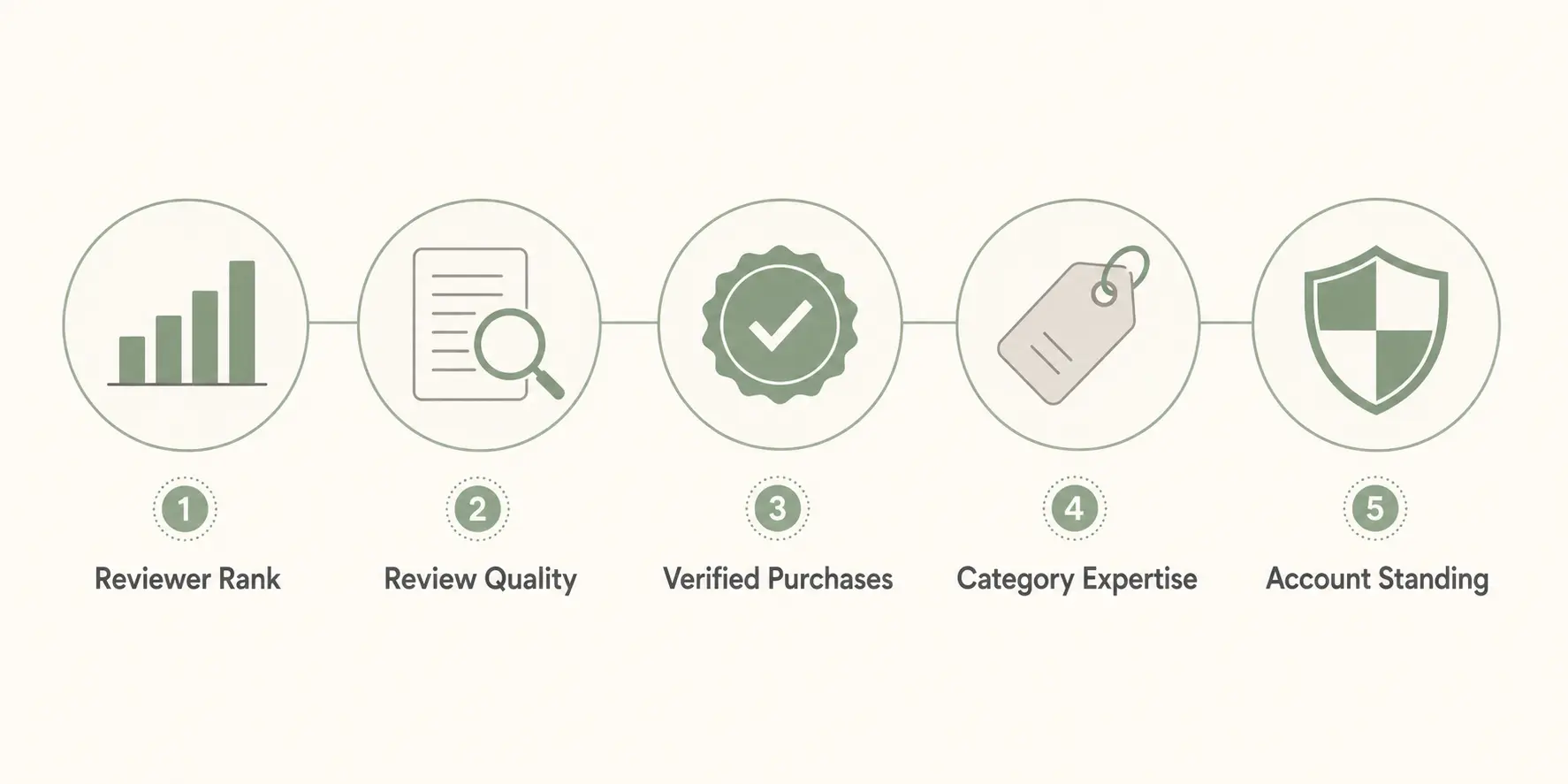
Amazon has never published the full selection criteria, but the company has confirmed the broad signals it weighs. Across Amazon's official program description and Vine Voice accounts shared publicly, five factors come up consistently.
1. Reviewer rank. Amazon assigns every account a hidden reviewer rank that reflects how helpful other shoppers have found your reviews. The rank weights recent reviews more heavily than older ones, so a six-month break in activity hurts you. Helpfulness votes from real customers are the primary driver.
2. Review quality. Detailed reviews that mention specific product attributes, compare to alternatives, include both pros and cons, and answer questions a buyer would actually ask are favored. One-line reviews, generic praise, and complaints about features clearly stated in the listing weaken your profile.
3. Verified purchase history. Amazon prioritizes reviewers who buy and use what they review. Most successful Vine Voice profiles show that the large majority of reviews come from verified purchases rather than free samples or unverified items.
4. Category expertise. Reviewers who consistently cover one or two product categories in depth signal that they understand those products well. Amazon assigns Vine invitations partly based on what enrolled sellers need reviewed, so demonstrated expertise in active categories (electronics, kitchen, home, beauty) raises your odds.
5. Account standing. Accounts with policy violations, fake-review history, or community guideline strikes are filtered out. The Amazon account being reviewed must be in clean standing, with a complete profile and real name where possible.
What does not matter, despite common myths: paid Amazon Prime status, total spend on Amazon, follower count, or external blog audience.
How to write reviews that get noticed
The reviews that trigger Vine invitations share a few practical traits. Use them as a checklist when you write.
- Aim for 150–400 words. Long enough to cover the product properly, short enough that shoppers actually read it.
- Open with the use case. Explain who the product is for and what problem it solves before listing features.
- Cover both strengths and weaknesses. Reviews that read as balanced get marked helpful more often than purely positive ones. For an example of balanced product-review style content, see our Qullnowisfap product review and safety check
- Include specifics. Battery life in hours, dimensions, build material, and how it compares to a similar product you owned.
- Add original photos when relevant. Especially for physical goods. A reviewer-supplied image is one of the strongest signals of authenticity.
- Write in your own voice. Amazon now uses detection systems for AI-generated review text. Using a language model to "clean up" grammar can trigger flags; conversational quirks and personal context are protective.
- Update reviews after extended use. A review edited at the three-month mark with durability notes carries more weight than a fresh-out-of-the-box first impression.
Avoid the patterns that push reviews down: vague praise ("great product, love it"), repetitive phrasing across multiple reviews, off-topic complaints (delivery speed, packaging, unless it's a quality issue), and copy-pasted content.
How long does it take to get invited?
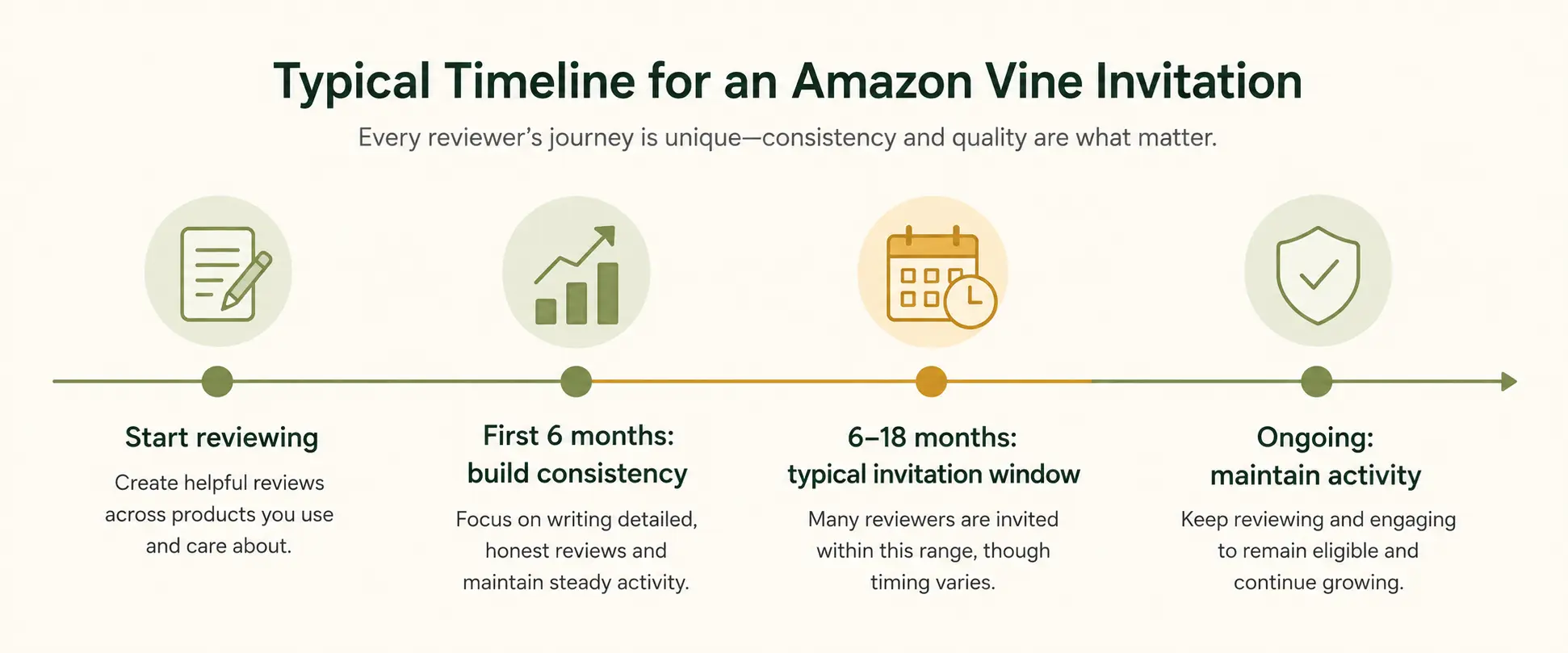
There is no fixed timeline, and reports vary widely. Some reviewers report invitations after as few as 10–20 quality reviews; others have written hundreds over many years without one. Amazon's own materials acknowledge that the process is not predictable from the outside.
The pattern in public Vine Voice testimonials suggests:
- Most invitations come after 6–18 months of consistent reviewing, not weeks.
- Reviewers who concentrate on 2–3 categories are invited faster than generalists.
- A steady cadence — say, two to four reviews per month over a year — outperforms a burst of 30 reviews in one week followed by silence.
- Recent activity matters most. Amazon has been weighing the last few months more heavily, so a long-dormant account with strong old reviews ranks lower than an active newer account.
Patience is the realistic baseline. The program runs continuously, recruits in waves, and weighs long-term consistency over spikes.
What happens after you receive an invitation
The invitation arrives as an email from Amazon. Once accepted, the new Vine Voice enters the Silver tier, which permits up to three item requests per day with a value cap (around $100 per item in the U.S. marketplace). The reviewer agrees to the Vine Participation Agreement, which sets out the review deadline, completion rate, and tax responsibilities.
The path from Silver to Gold tier — eight items per day, no value cap — requires reviewing at least 80 Vine items with a 90% completion rate inside Amazon's evaluation window. Each tier has its own maintenance threshold, and falling below it can place an account under review or close it entirely. The detailed walkthrough on the differences between Vine reviewer tiers compares the two side by side.
A few obligations Vine Voices often miss until they're inside:
- Reviews must be published within 30 days of receiving the product.
- Vine items received from third-party sellers cannot be sold or given away for six months.
- Amazon may issue a U.S. tax form for the estimated value of Vine items received in a calendar year once it reaches the IRS reporting threshold. Tax rules in other countries vary.
Common mistakes that hurt your chances
Most reviewers who never get invited share one of these patterns.
Review padding. Posting many low-effort reviews to boost your count. Amazon's algorithm reads engagement, not volume.
Incentivized reviews from outside Amazon. Accepting free products from Facebook groups or rebate sites in exchange for reviews violates Amazon's policy and disqualifies the account.
Inconsistent voice or copied phrasing. Pattern-matching across reviews flags accounts as suspicious, even when the reviews are written by a human.
Profile incompleteness. Anonymous profiles, missing real names, or empty bios send a low-credibility signal.
Reviewing only freebies or sweepstakes wins. A low verified-purchase ratio is one of the strongest negative signals.
Negative-review-only history. Reviewers who only post 1- and 2-star reviews look biased to the algorithm. Balance matters.
Correcting these habits will not produce an invitation by next week, but they are the difference between an account the algorithm considers and one it skips.
Frequently asked questions
Is there a minimum number of reviews needed to become a Vine Voice?
No. Amazon has not published a threshold, and invitations have gone to reviewers with as few as 10 to 20 quality reviews. Helpfulness and consistency matter more than count.
Does Amazon Vine cost anything to join?
No. Vine is free for reviewers. There is no membership fee, no application charge, and no Amazon Prime requirement. Any site charging for Vine access is not affiliated with Amazon. Readers comparing free products, earnings, and taxable value can also review net worth vs income vs salary vs revenue
Can I contact Amazon to request a Vine invitation?
No. Amazon Customer Service cannot grant access or escalate accounts to the Vine team. The selection is entirely algorithmic.
Do verified purchase reviews count more than unverified ones?
Yes. Verified-purchase reviews carry significantly more weight in Amazon's helpfulness and trust signals. A high proportion of verified reviews on your profile is one of the clearer positive markers.
Can my account be considered if I review across many categories?
Yes, but focused expertise in two or three categories is generally favored over scattered coverage of dozens. Sellers in active Vine categories drive much of the demand for new reviewers.
Will posting product photos help my chances?
Likely yes. Original images attached to reviews tend to receive more helpful votes, which lifts your reviewer rank — and rank correlates strongly with invitation likelihood.
Can a Vine invitation be revoked?
Yes. Failure to meet review deadlines, falling below completion rate requirements, or violating the Vine Participation Agreement can trigger an account review or closure. Closure decisions are final.
Final word
Becoming a Vine Voice is not a process you can rush, game, or apply for. It is a slow accumulation of credibility that Amazon's algorithm tracks across every review you publish. The reviewers who get invited are the ones who would have written careful, helpful reviews regardless — the invitation is a side effect of being useful to other shoppers, not the goal of the activity.
If you are currently writing reviews mainly to qualify for Vine, the strategy will probably fail. If you write because you have something genuinely useful to say about products you own, the invitation tends to follow.
Last reviewed: May 2026. Source references: amazon.com/vine/about, Amazon community guidelines for reviewers, Vine Participation Agreement.


