


The Big Five is generally the stronger choice when you want a research-based description of your personality traits. The Myers-Briggs Type Indicator (MBTI) is designed to help people explore personality preferences using 16 recognizable types. Both can encourage self-reflection, but they measure and present personality differently, and neither can tell you exactly who you are or what you will achieve.
If you have ever received an INTJ or INFJ result and wondered whether it is scientifically meaningful, understanding the difference between types and traits is a good place to start.
Key Takeaways
- MBTI uses four preference pairs to describe 16 personality types, such as INFJ, INTJ, ENFP, and ISTJ.
- The Big Five measures five broad personality traits, generally represented as continuous scores rather than fixed categories.
- The Big Five has a well-established research tradition, although the quality of an individual questionnaire still matters.
- MBTI can provide a useful vocabulary for reflection, but research has challenged the idea that people fall into sharply separated personality types.
- Neither assessment should be used alone to diagnose a psychological condition, determine career potential, or judge relationship compatibility.
What Are the MBTI and Big Five Personality Tests?
Although people sometimes use the names interchangeably, the MBTI and Big Five are different approaches to describing personality.
What is MBTI?
The Myers-Briggs Type Indicator is a personality assessment based on psychological type theory. Its framework describes preferences across four pairs:
| Preference pair | What it explores |
|---|---|
| Extraversion (E) / Introversion (I) | Where you prefer to direct attention and energy |
| Sensing (S) / Intuition (N) | How you prefer to take in information |
| Thinking (T) / Feeling (F) | How you prefer to make decisions |
| Judging (J) / Perceiving (P) | How you prefer to approach the outside world |
Combining one preference from each pair creates a four-letter type.
For example, INTJ represents Introversion, Intuition, Thinking, and Judging. INFJ replaces Thinking with Feeling.
The Myers & Briggs Foundation's explanation of the 16 types describes these categories as preferences, not measures of intelligence, ability, or personal worth.
This distinction is important. Someone who prefers Thinking can still make compassionate decisions. Someone who prefers Feeling can be highly analytical.
MBTI descriptions can give people language for discussing their habits, but a type should not be treated as a rigid behavioral rule.
What is the Big Five personality model?
The Big Five, also called the Five-Factor Model, describes personality through five broad dimensions.
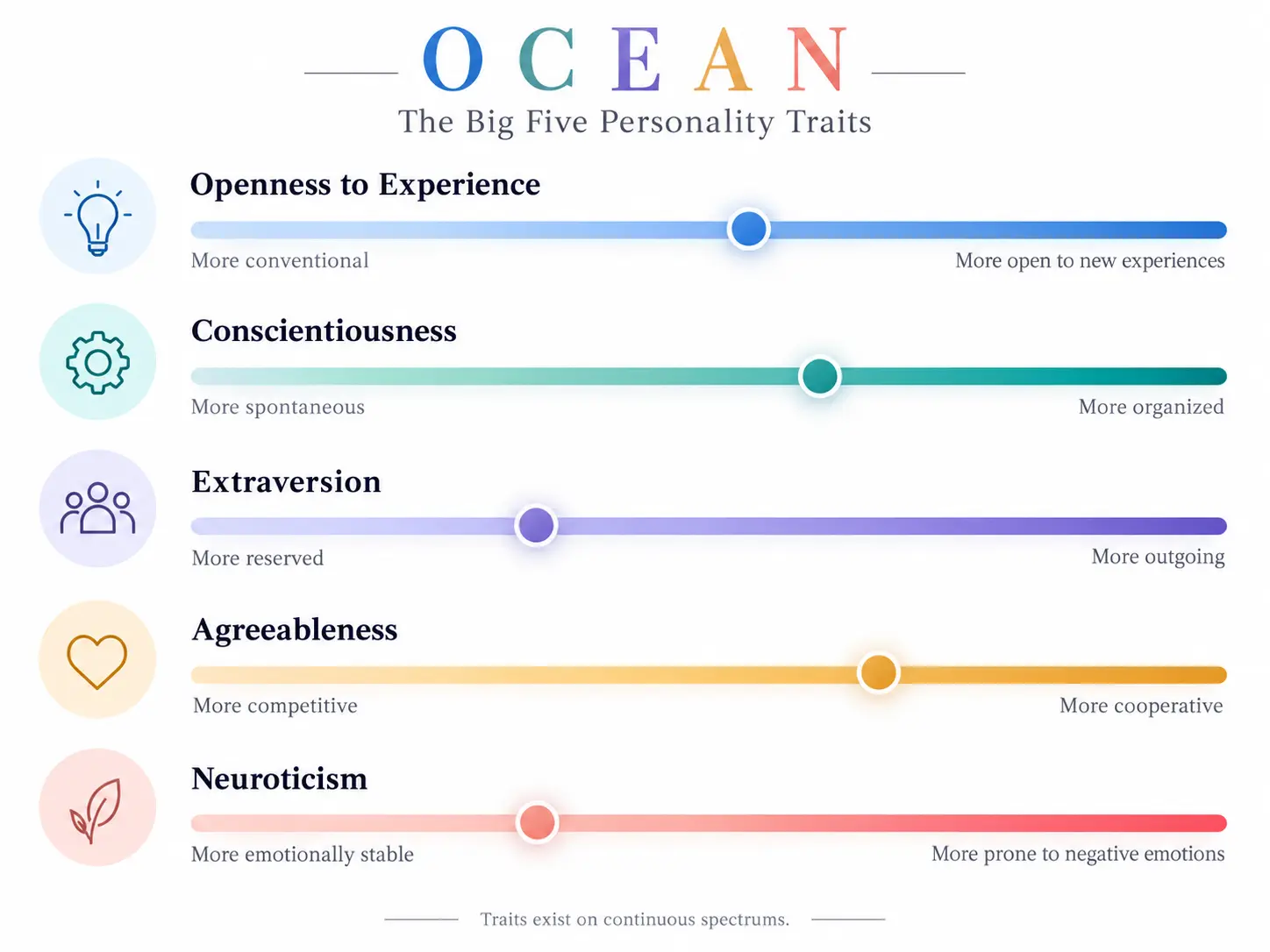
A familiar acronym is OCEAN:
- Openness to Experience: Interest in ideas, novelty, imagination, and new experiences.
- Conscientiousness: Tendencies involving organization, responsibility, and goal-directed behavior.
- Extraversion: Tendencies involving sociability, assertiveness, and social energy.
- Agreeableness: Tendencies involving cooperation, compassion, and consideration for others.
- Neuroticism: Tendencies toward negative emotions such as worry and emotional distress.
Some research instruments use different labels. For example, the Big Five Inventory–2 (BFI-2) uses Open-Mindedness and Negative Emotionality for two of its five dimensions.
The Berkeley Personality Lab explains that its BFI-2 questionnaire measures five broad traits and 15 more specific facets.
Instead of assigning a person to one overall personality category, a Big Five assessment can describe a combination of tendencies.
You might score relatively high in openness, moderate in extraversion, and lower in conscientiousness. That combination describes different aspects of you without forcing them into one four-letter label.
MBTI vs Big Five: Key Differences
The central difference is that MBTI emphasizes personality preferences organized into types, while the Big Five emphasizes variation across measurable traits.
| Feature | MBTI | Big Five |
|---|---|---|
| Main approach | Type-based interpretation | Trait-based measurement |
| Main result | One of 16 four-letter types | Scores on five broad traits |
| Structure | Four preference pairs | Five continuous dimensions |
| Typical purpose | Self-awareness and personal development | Personality description and research |
| Research foundation | Psychological type theory with a history of assessment research and debate | Extensively studied trait framework |
| Strength | Memorable language for discussing preferences | More detailed representation of differences in trait levels |
| Limitation | Type boundaries can oversimplify continuous differences | Scores depend on questionnaire quality, context, and interpretation |
| Hiring suitability | Not designed for selecting job applicants | Use in employment assessment requires separate validation and appropriate professional safeguards |
| Clinical diagnosis | Not suitable | Not a diagnostic tool by itself |
1. Types versus continuous traits
Imagine two people complete an assessment.
One falls slightly on the introverted side of an MBTI preference pair, while another falls slightly on the extraverted side.
A four-letter type result places them in different categories, even if their underlying preferences are relatively similar.
A trait-based questionnaire can instead represent their extraversion scores as nearby positions on a continuum.
That difference matters when you want to understand variation between people rather than simply identify a preferred category.
Research by Robert McCrae and Paul Costa examined MBTI results against the Five-Factor Model. Their 1989 study in the Journal of Personality did not support the idea that the measured preferences formed sharply distinct personality categories. It did find that several MBTI dimensions corresponded with aspects of broader personality traits.
That finding does not mean every MBTI observation is meaningless. It means that a continuous-trait interpretation may better represent what certain assessment responses measure.
2. Different levels of detail
A type result can be easy to remember.
For instance, someone may describe themselves as an INTJ because they identify with being independent, organized, and interested in long-term plans.
But two people with the same four-letter type can have noticeably different emotional responses, social habits, and levels of organization.
The Big Five describes these characteristics separately.
Its more detailed instruments can go further. The BFI-2 includes facets such as sociability, assertiveness, organization, responsibility, and intellectual curiosity.
According to Soto and John's BFI-2 development study, these specific facets were designed to provide a more detailed assessment within the five broad dimensions.
That makes the Big Five particularly useful when a general personality label leaves important questions unanswered.
3. Different ways of communicating results
MBTI descriptions often use recognizable language about personal preferences.
Someone might find it easier to start a conversation by saying, "I usually need time to think before discussing a decision."
A Big Five report may express a related tendency as a relatively lower score on extraversion, potentially accompanied by more specific facet scores.
Neither statement gives a complete picture.
The MBTI description may be easier to discuss informally. The Big Five score may be more useful when someone wants to compare the degree of a particular tendency.
The best interpretation depends on the question being asked.
Which Personality Test Is More Scientifically Accurate?
For measuring broad personality traits, the Big Five has the stronger foundation in mainstream personality research. However, scientific accuracy depends on the specific assessment, the quality of its validation studies, and the use being made of the results.
A personality questionnaire should be evaluated by more than whether its description feels relatable.
Researchers examine questions such as:
- Reliability: Does the instrument measure traits consistently?
- Construct validity: Does it actually measure the characteristics it claims to measure?
- Predictive validity: Do its scores have demonstrated relationships with relevant outcomes?
- Interpretability: Are results explained appropriately for the people taking the test?
- Suitability: Is the instrument appropriate for the intended population and purpose?
What research says about the Big Five
The Big Five is supported by an extensive body of personality research, including studies examining the structure and measurement of broad personality traits.
One example is the Big Five Inventory–2, developed by Christopher Soto and Oliver John and published in the Journal of Personality and Social Psychology in 2017.
The instrument includes 60 items, five broad dimensions, and 15 narrower facets.
Its development involved evaluating how well the instrument measured its intended traits and related to other measures.
The U.S. National Cancer Institute's measurement resource also identifies the BFI-2 as a structured personality measure covering these five domains and 15 facets.
However, "Big Five" does not identify one universal test. Different questionnaires may have different lengths, scoring systems, comparison samples, and evidence.
A poorly designed online quiz does not become scientifically sound merely because it uses the Big Five label.
What research says about MBTI
The MBTI has its own assessment manuals, development history, and published evidence. Its publisher describes it as a tool for understanding preferences and supporting personal development.
However, researchers have challenged key elements of the underlying type theory.
A 2019 review by Randy Stein and Alexander Swan examined the scientific validity of MBTI theory and identified substantial theoretical and empirical concerns, particularly around the concept of distinct, fixed personality types.
The older McCrae and Costa study likewise questioned whether MBTI results establish clearly separated categories.
These criticisms should not be confused with a claim that all four underlying response dimensions contain no useful information.
They also should not be confused with the publisher's intended use of the MBTI as a facilitated self-development exercise rather than a job-selection or diagnostic instrument.
So which one wins?
The answer depends on what you mean by accuracy.
If you want a nuanced, research-oriented description of your personality traits, a well-validated Big Five instrument is generally the better starting point.
If you want structured language for reflecting on your preferences and discussing different approaches with other people, an appropriately interpreted MBTI assessment may still be useful.
The mistake is treating either result as an objective verdict about your intelligence, value, future, or abilities.
Which Test Should You Use for Work, Relationships, and Personal Growth?
The most useful question is not simply which system is more popular. It is what you are trying to learn.
For personal self-understanding
Consider the Big Five first if you want to understand several aspects of your personality independently.
For example, perhaps you enjoy creative problem-solving but struggle to keep your schedule organized.
A Big Five profile can separate openness-related tendencies from conscientiousness-related tendencies.
This is more informative than assuming that being creative automatically means being disorganized.
An MBTI result may be useful as a starting vocabulary for reflecting on how you approach information, decisions, and social situations.
Treat either result as a prompt for observation, not an identity you must defend.
For career exploration
Personality can inform career reflection, but it should never be the only factor.
Imagine someone receives an INTJ result and reads that INTJs are often associated with analytical careers.
That description might encourage the person to explore software development, research, or strategic planning.
But it does not establish that the person has the necessary abilities, qualifications, interest, or circumstances for those occupations.
Similarly, a Big Five result cannot determine a person's ideal job.
A better career decision considers:
- Actual interests and preferred daily tasks.
- Existing skills and opportunities for training.
- Required qualifications and job-market conditions.
- Working environment and practical constraints.
- Personal values and long-term priorities.
The Myers & Briggs Foundation's career guidance explicitly distinguishes career exploration from hiring selection.
For readers interested in how personality labels are discussed in career content, Spread Thoughts also has a guide to careers for INTJ personality types. Such descriptions are best treated as ideas to investigate, not occupational restrictions.
For relationships
Personality results can help people explain differences in preferences, but they cannot establish whether two people will form a successful relationship.
For example, one partner may enjoy frequent social activities while the other needs more quiet time.
Understanding extraversion-related differences can help them discuss how to balance their needs.
It does not determine whether they communicate respectfully, share values, or handle disagreements constructively.
Likewise, there is no sound basis for assuming that two people are automatically compatible or incompatible because their four-letter type codes match or differ.
Actual behavior and communication matter more than a convenient label.
For workplace teams
A personality framework may support voluntary conversations about communication and working preferences.
For example, team members might discuss whether they prefer written preparation before meetings or enjoy brainstorming ideas aloud.
Those are practical discussions when the participants can describe their real preferences and adapt their behavior.
However, using an MBTI result to eliminate job applicants or assign someone permanently to a role is inappropriate.
The Myers-Briggs Company states that the MBTI should not be used for recruitment or selection.
Other assessments also require purpose-specific evidence and safeguards before being used in employment decisions.
Is 16Personalities the Same as MBTI or Big Five?
This is an important distinction because many readers receive a four-letter type from a free online test and assume they have taken the official MBTI.
The popular website 16Personalities uses its own NERIS framework.
It retains familiar four-letter labels such as INTJ and INFJ, but its model is not identical to the official MBTI assessment.
The company's description of its framework explains that it uses five trait-like scales and adds an additional identity dimension.
That is why someone may receive a result such as:
- INTJ-A
- INTJ-T
- INFJ-A
- INFJ-T
The -A and -T suffixes belong to the 16Personalities framework; they are not a fifth MBTI preference pair.
This matters when comparing scores or reading research about the MBTI. Evidence about the official MBTI cannot automatically be applied to every online assessment using similar type labels.
Before interpreting a personality test, check exactly which questionnaire or framework produced the result.

How to Choose a Personality Test Without Being Misled
You do not need to become a psychologist to ask useful questions about an assessment.
Use this five-step checklist.
Step 1: Decide what you want to learn
Write a specific question before taking a test.
For example:
- What personal habits might affect how I organize my work?
- How comfortable am I in different social situations?
- Why do I prefer certain approaches to decisions?
- Which work environments should I explore further?
A clear question helps you avoid treating an entertaining personality profile as an answer to everything.
Step 2: Identify the actual questionnaire
Look for the assessment's name, creator, and model.
Do not assume every four-letter quiz is the official MBTI.
Do not assume every online test advertising five traits is the BFI-2 or another validated Big Five instrument.
If you want to explore a research-based Big Five measure, the Berkeley Personality Lab's BFI-2 resource is a useful starting point. It explains the measure and links to a way to take it online.
Step 3: Check whether the evidence matches the claim
If a website says its assessment is scientifically validated, look for information about:
- The exact version of the questionnaire.
- Published reliability and validity studies.
- The people and populations studied.
- The intended purpose of the assessment.
- The limits of its conclusions.
A statement such as "used by millions" is about popularity, not necessarily measurement accuracy.
Step 4: Read scores as tendencies, not destiny
Suppose you receive a relatively low extraversion score.
That does not mean you cannot speak confidently in public or enjoy meeting people.
It describes a pattern of responses to questions about certain tendencies.
Likewise, an MBTI introversion preference does not establish that you dislike every social activity.
Consider how your behavior changes across situations, responsibilities, and relationships.
Step 5: Turn the result into a useful observation
A personality result is most valuable when it helps you examine an actual behavior.
For example:
Observation: "I find it difficult to keep track of multiple deadlines."
Possible next step: Experiment with a single task list, scheduled reminders, or smaller project milestones.
You do not need to conclude that your personality type permanently prevents you from becoming organized.
Use the result to identify a practical question, then evaluate what works in real life.
Limitations of Both Personality Models
Neither MBTI nor the Big Five offers a complete description of an individual.
Self-report questionnaires depend partly on how people understand questions, remember behavior, and describe themselves.
The same person may behave differently with friends, family, colleagues, or strangers.
Scores and interpretations must also be considered in relation to the specific questionnaire and population.
There are several common mistakes to avoid.
Treating a label as a permanent identity. A personality category is a simplified description, not an unchangeable definition of who someone is.
Assuming similarity means compatibility. Shared preferences do not guarantee a successful friendship, partnership, or working relationship.
Using a personality score to measure ability. A preference or trait is not the same thing as intelligence, professional competence, or a learned skill.
Confusing personality with mental health. Neither a regular MBTI profile nor a general Big Five questionnaire is a substitute for clinical evaluation.
Trusting an online quiz simply because its description feels accurate. A compelling description is not by itself evidence of reliable measurement.
The most responsible approach is to use personality information as one limited source of self-knowledge, alongside real experiences, feedback, goals, and circumstances.
Frequently Asked Questions
1. Is the Big Five more accurate than MBTI?
For research-based assessment of broad personality traits, a well-validated Big Five questionnaire is generally the stronger choice. The MBTI has a different purpose and emphasizes interpreting personality preferences through types.
2. Is MBTI scientifically proven?
The official MBTI has published assessment research and manuals, but important elements of its underlying type theory remain scientifically contested. Research has particularly challenged the idea that people fall into sharply separated personality categories.
3. Can someone be both INTJ and high in agreeableness?
Yes. The two systems describe personality differently, and there is no exact one-to-one translation between an MBTI type and all five Big Five trait scores. A four-letter type does not determine a person's entire trait profile.
4. What is the most important difference between MBTI and Big Five?
MBTI organizes preferences into 16 types. Big Five assessments describe how a person scores across five trait dimensions. This affects both how results are reported and how they can be interpreted.
5. Is 16Personalities an official MBTI test?
No. The 16Personalities website uses its own NERIS assessment framework. It uses familiar type labels but is not the official Myers-Briggs Type Indicator.
6. Can Big Five scores change over time?
Personality traits can show both continuity and change, but changes in a questionnaire score can also reflect measurement conditions and response differences. One score should not be treated as permanent or as proof of personal transformation.
7. Should employers use MBTI to hire employees?
No. The Myers-Briggs Company specifically states that the MBTI is not intended for recruitment or employee selection. Any assessment used in hiring requires evidence that it is appropriate and valid for that particular purpose.
8. Can a personality test tell me which career or partner is best for me?
No. A personality assessment may help you consider preferences and tendencies, but career success and relationship outcomes depend on many additional factors. Use the results for reflection rather than as a final decision-making rule.
Final Thoughts
The MBTI and Big Five approach personality from different perspectives.
The MBTI gives people recognizable language for discussing preferences. The Big Five offers a continuous-trait framework with a substantial research foundation.
If your goal is to understand your personality using established psychological measurement, start with a well-validated Big Five questionnaire. If you enjoy exploring the meaning of a personality type, MBTI can still provide topics for thoughtful reflection.
Neither framework should define your limits.
If you want to explore how two popular MBTI labels are commonly compared, continue with our guide to INFJ vs INTJ personality differences, keeping in mind that type descriptions are interpretations rather than certain predictions of individual behavior.


