


Substack is a strong starting point for writers who want to publish a newsletter, build a community and offer paid subscriptions without a fixed monthly platform fee. beehiiv is worth considering for creators and publishers who want more email marketing controls, automation and a pricing model that doesn't take a percentage of subscription revenue.
Both platforms support free newsletters, websites and audience growth. The better choice depends on how you plan to attract readers, earn revenue and manage your publication.
This comparison examines their current pricing models, publishing tools, monetization options and switching requirements, including situations where neither platform's paid features are necessary.
Key Takeaways
- Both platforms offer free publishing, but their limits and monetization models differ.
- Substack takes 10% of paid subscription revenue, plus applicable payment processing costs.
- beehiiv offers free publishing for up to 2,500 subscribers and paid plans with a 0% platform fee on paid subscriptions.
- Substack emphasizes its reader network, Notes, recommendations and creator-community features.
- beehiiv emphasizes publication growth tools, email automation, analytics and additional monetization options.
- The right choice depends on your revenue model, audience size and workflow—not just the advertised starting price.
What Is the Difference Between Substack and beehiiv?
Substack and beehiiv are publishing platforms that let creators build an audience through email newsletters and online content.
Both provide tools for publishing posts, managing subscribers and operating a newsletter without building an entire email delivery system from scratch.
However, they differ in how they approach publishing and growth.
What is Substack?
Substack is a publishing platform built around writers, creators and their audiences.
It combines email newsletters, website publishing, paid subscriptions, podcasts and community features.
A creator can start publishing without paying a recurring platform subscription.
Substack also operates a reader-facing network that includes Notes, recommendations and its own app.
These tools can help readers discover publications and interact with creators without leaving the Substack ecosystem.
According to Substack's official platform overview, its publishing tools are designed to connect writing, email, community and subscriptions in one environment.
This can appeal to independent writers who prefer concentrating on their editorial work rather than configuring a broader marketing system.
What is beehiiv?
beehiiv is a newsletter and audience-growth platform that combines publishing tools with email marketing and monetization features.
It supports newsletters, websites and other creator-oriented products.
Its paid plans include capabilities such as email automations, advertising tools, audience polls and expanded analytics.
beehiiv also offers a recommendation network through which publishers can promote other publications.
The platform's pricing structure includes a free tier and paid tiers that vary by subscriber count.
Its official pricing and feature page explains the available products and plan differences.
Side-by-side comparison
| Feature | Substack | beehiiv |
|---|---|---|
| Free publishing | Yes | Yes, with free-plan subscriber limits |
| Main pricing approach | Percentage of paid subscription revenue | Free and paid feature tiers |
| Platform fee on paid subscriptions | 10% | 0% on eligible paid plans |
| Payment processing | Additional fees | Additional fees |
| Website publishing | Included | Included |
| Reader discovery | App, Notes and recommendations | Recommendations and audience-growth features |
| Email automation | More limited marketing automation focus | Dedicated automation features on paid plans |
| Paid subscriptions | Available without a fixed monthly platform fee | Available on appropriate paid plans |
| Custom domains | Available with an additional one-time platform fee | Supported; plan conditions should be checked |
| Podcast publishing | Available | Available |
| Data export | Supported | Supported |
This table summarizes platform capabilities rather than guaranteeing that every feature is available on every plan.
Both services can change their offerings, so creators should verify the specific plan they intend to purchase.
Substack vs beehiiv Pricing: What Will You Actually Pay?
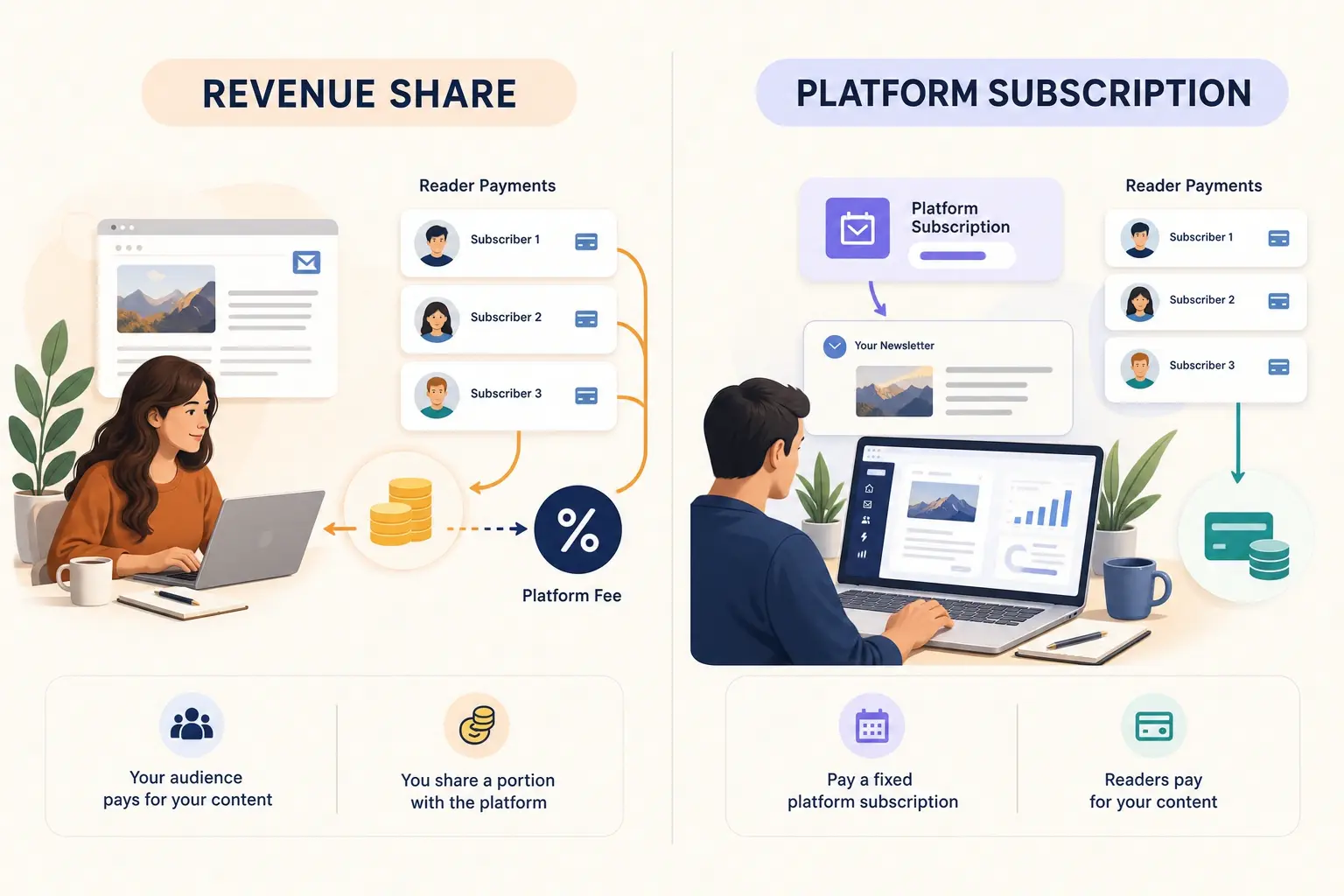
Pricing is one of the most important differences for someone planning to earn money from a newsletter.
Substack generally charges based on paid subscription revenue.
beehiiv provides free publishing and charges a recurring subscription for certain advanced tools, including paid-newsletter monetization.
These models can produce very different costs as a publication grows.
How much does Substack cost?
Publishing a free newsletter on Substack does not require a recurring platform subscription.
You can publish content and build a free subscriber list without paying for a fixed monthly publishing plan.
When you enable paid subscriptions, Substack keeps 10% of subscription revenue.
Payment processing fees also apply.
According to Substack's official cost documentation, its example fees for US card transactions include:
- A 10% Substack platform fee.
- Stripe card processing of 2.9% plus $0.30 per transaction.
- A Stripe Billing fee of 0.7% for recurring payments.
- An optional $50 one-time fee for connecting a custom domain.
Other payment methods, currencies and regions can have different processing costs.
A custom domain is optional, and the one-time connection fee does not include purchasing the domain itself.
The advantage is that creators do not have to pay a fixed platform subscription before earning money.
The disadvantage is that the percentage fee increases as paid subscription revenue grows.
How much does beehiiv cost?
beehiiv offers a free plan for creators getting started.
Its current plan structure includes Free, Lite, Pro and Enterprise.
The Free plan supports up to 2,500 subscribers and includes core publishing capabilities.
Paid plans unlock additional tools and higher audience limits.
As checked on November 5, 2026, beehiiv advertised the following entry prices for a publication at the 1,000-subscriber pricing tier:
| beehiiv plan | Advertised starting price | Main purpose |
|---|---|---|
| Free | $0 | Basic publishing and audience building |
| Lite | $49/month, billed annually | Monetization, automation and growth tools |
| Pro | $95/month, billed annually | Expanded publishing, analytics and team capabilities |
| Enterprise | Custom pricing | Larger organizations with advanced requirements |
The paid prices shown are monthly equivalents under annual billing, not month-to-month payment amounts.
At the same starting subscriber tier, beehiiv's published monthly-billing entry prices are $59 for Lite and $109 for Pro.
Paid-plan prices increase at higher subscriber tiers.
The company changed its plan names and pricing structure in October 2026. Older articles that refer to Launch, Scale or Max may describe the previous plans.
The beehiiv pricing guide documents the newer Free, Lite and Pro structure.
An important distinction is that beehiiv's 0% platform take rate does not eliminate payment processing fees.
Which is cheaper for a paid newsletter?
It depends on your monthly paid subscription revenue.
Consider a creator who charges $10 per month for a paid newsletter.
The following illustration compares only Substack's 10% platform share with beehiiv Lite's advertised starting fee of $49 per month under annual billing.
| Paying subscribers | Monthly gross revenue | Substack platform fee | beehiiv Lite starting fee |
|---|---|---|---|
| 25 | $250 | $25 | $49 |
| 50 | $500 | $50 | $49 |
| 100 | $1,000 | $100 | $49 |
| 250 | $2,500 | $250 | $49 |
Illustrative calculation only. It excludes payment processing, taxes, refunds, annual commitment costs and higher beehiiv pricing tiers. The $49 Lite rate is the advertised annual-billing equivalent at the entry subscriber tier.
At these assumptions, the two platform-fee amounts become approximately equal when monthly paid subscription revenue reaches $490.
The calculation is straightforward:
$490 × 10% = $49
That is a fee-only comparison, not a universal recommendation to change platforms at $490.
A creator with lower revenue may prefer avoiding any fixed monthly platform cost.
A creator earning more from paid subscriptions may find beehiiv's model financially attractive, provided its features, subscriber tier and billing terms fit.
The value of each platform's other services also matters.
What costs are often overlooked?
A newsletter budget should account for more than the headline publishing fee.
Possible additional costs include:
- Payment processing and recurring billing fees.
- Custom domain registration and renewal.
- Higher subscriber tiers.
- Annual commitments and renewal conditions.
- Optional integrations and external services.
- Time spent on migration, setup or ongoing administration.
Creators outside the United States should also verify country-specific Stripe availability, taxes, currencies and billing conditions.
A US-dollar pricing example should not be treated as an exact quote for publishers in the UK, Australia or Canada.
Which Platform Is Better for Growing an Audience?
A newsletter platform can help distribute content, but it cannot guarantee that people will subscribe.
Audience growth depends on the content, target audience, publishing consistency and promotion strategy.
The platforms approach discovery differently.
Substack's reader network
Substack combines newsletter publishing with a social discovery environment.
Readers can find publications through recommendations, Notes and the Substack app.
Writers can participate in conversations and build relationships with other creators and readers.
For a publication focused on commentary, essays, analysis or personal writing, these features may align naturally with the publishing process.
A creator who enjoys engaging with readers through social posts and discussions may value having those tools alongside the newsletter.
However, being present on Substack does not guarantee visibility.
Growth still depends on whether people find and value the content.
beehiiv's recommendation and marketing tools
beehiiv offers a recommendation network and tools designed to support newsletter acquisition and retention.
Depending on the plan, publishers can use additional features such as automations, audience polls and testing.
For example, a creator might build an automated welcome sequence for new subscribers or analyze which subscription sources produce engaged readers.
These tools can be useful for a newsletter operated as a marketing channel or a growing media product.
However, the presence of additional analytics and automation controls does not necessarily make the publication more successful.
They provide options that must be configured, maintained and used intelligently.
What should you measure?
Instead of assuming that one platform will generate more subscribers, compare outcomes such as:
- New subscribers acquired from each channel.
- Reader engagement and returning audience behavior.
- Free-to-paid subscription conversion.
- Paid subscriber retention and cancellations.
- Revenue relative to platform and operating costs.
- Time required to publish and manage each issue.
These measurements help determine whether a platform supports the actual goals of your publication.
For a broader approach to developing an audience, Spread Thoughts has a guide to building a recognizable brand as a blogger.
Which Is Better for Making Money From a Newsletter?
A newsletter can earn revenue in several ways, and the monetization model influences which software features matter most.
Paid subscriptions
Paid subscriptions allow readers to support a creator or purchase access to selected content.
Substack lets eligible creators turn on paid subscriptions without committing to a monthly publishing fee.
It takes a percentage of the resulting subscription revenue.
beehiiv's paid tiers support subscription monetization with a 0% platform take rate, excluding applicable payment processing charges.
For creators who do not yet have paying readers, Substack's fee model can reduce the financial commitment required to test paid content.
For an established paid newsletter, beehiiv's fixed-plan model may be attractive, especially when the subscription-fee difference exceeds the cost of the appropriate tier.
Advertising and sponsorships
Some newsletters earn money through advertisements or direct sponsorship arrangements.
beehiiv offers an advertising network and related monetization tools on eligible plans.
These features can help publishers manage opportunities, although acceptance, available campaigns and earnings are not guaranteed.
Substack writers can also arrange sponsorships independently, but the platforms differ in their built-in advertising workflows.
A publisher planning to monetize primarily through advertisements should compare the relevant advertiser tools, audience requirements and actual opportunities—not just subscription pricing.
Digital products and other offers
A creator may want to sell additional products such as ebooks, courses or downloadable resources.
beehiiv provides creator-commerce features, with availability and limits varying by plan.
Substack focuses more directly on publication subscriptions and community-supported publishing.
Neither approach automatically determines which business model is more profitable.
For example, a writer whose main product is a paid essay subscription may value a streamlined publication experience.
A creator selling several products to an email audience may need a more flexible marketing and commerce workflow.
Which Platform Should You Choose for Your Publishing Goals?
The most useful approach is to compare the work you need to do—not just the number of features listed on each website.
| Your publishing situation | Platform to evaluate first | Reason |
|---|---|---|
| Independent writer starting a free publication | Substack or beehiiv Free | Both support basic publishing without fixed platform costs |
| Writer testing paid subscriptions with no established revenue | Substack | No fixed monthly platform subscription is required |
| Publication with significant recurring paid revenue | beehiiv Lite or higher | A 0% platform take rate may make the cost model attractive |
| Creator who enjoys reader discussions and a built-in social ecosystem | Substack | Notes, recommendations and reader-app features |
| Newsletter requiring marketing automations and structured growth workflows | beehiiv | Dedicated automation and marketing features |
| Publisher relying on an advertising-led model | beehiiv | Built-in advertising tools on eligible plans |
| Creator with a large free audience but little revenue | Compare both carefully | Subscriber-tier pricing and monetization needs become important |
These are evaluation starting points, not guaranteed winners.
When Substack may be sufficient
Substack may suit a creator who wants to write, publish and communicate with an audience without managing a complicated marketing system.
It can also make sense when paid subscription revenue is uncertain or relatively small.
The platform's existing reader network may appeal to writers who want to participate in conversations with other authors and subscribers.
When beehiiv may be worth paying for
beehiiv may suit a publisher who wants more structured email marketing workflows or expects subscription revenue to justify a recurring platform fee.
Its automation, analytics and monetization capabilities may also appeal to creators operating a newsletter as a business rather than only as a writing project.
However, the cost must be compared with the appropriate subscriber tier.
When neither paid plan is necessary
If you are starting your first newsletter, a free plan may be entirely sufficient.
You can learn whether people want to read your content before purchasing more sophisticated tools.
A paid subscription becomes worthwhile when it solves a real problem, such as missing automation, insufficient audience capacity or a proven revenue-model requirement.

Can You Switch Between Substack and beehiiv?
Yes. Both services document ways to move newsletter content and subscribers between platforms.
However, migration is not always a simple one-click process.
Moving from Substack to beehiiv
beehiiv provides official migration instructions covering content, subscribers and paid memberships.
The documented workflow includes exporting newsletter data, importing subscribers and reviewing paid content.
One important limitation is that imported content does not always retain every original element.
For example, paywall placement and some content structures may require manual changes.
Paid subscriber migration also requires special attention.
If the old platform continues billing subscribers after the migration is complete, some readers could face duplicate charges.
Moving from beehiiv to Substack
Substack also provides a platform-specific migration guide.
It covers exporting subscriber records and importing publication content.
However, premium posts and other specialized content may not transfer with identical formatting or access settings.
Migration checklist
Before changing newsletter platforms:
- Export and securely back up subscribers and content.
- Confirm that the subscriber list was obtained with appropriate consent.
- Review which posts, media types and custom fields are supported.
- Check domain ownership and publication URL changes.
- Test the new signup process and email delivery.
- Carefully map paying subscribers, renewal dates and access rights.
- Verify billing on both platforms to avoid unintended duplicate charges.
- Check whether existing article URLs need redirects and whether important links still work.
The ability to download subscribers is valuable, but it does not mean every platform feature, payment arrangement or historical post will transfer automatically.
Frequently Asked Questions
1. Is beehiiv free like Substack?
Both offer free publishing. Substack does not impose a fixed monthly platform subscription for publishing, while beehiiv's free plan has a subscriber limit and restricts certain paid monetization and advanced features.
2. Does beehiiv take a percentage of paid subscriptions?
beehiiv advertises a 0% platform take rate on paid subscriptions through eligible plans. Payment processing fees still apply.
3. Is Substack better for beginners?
It can be a suitable starting point for creators who want to publish without paying a fixed monthly platform fee. However, beehiiv's free plan is also a viable option for beginners who prefer its publishing and audience tools.
4. Can I have a custom domain on both platforms?
Both support custom domains, but setup requirements and charges differ. Substack documents an optional one-time $50 connection fee, separate from purchasing the domain. Check beehiiv's current plan conditions and domain setup documentation for the specific account.
5. Which platform is better for paid newsletters?
Substack may suit creators who want to test paid subscriptions without recurring platform charges. beehiiv may become financially attractive when recurring subscription revenue and required features justify the appropriate paid plan.
6. Can I move my subscribers if I change platforms?
Both providers offer subscriber export and import tools. Paid subscriptions, custom fields, content formatting and publication URLs may require additional work, so review the official migration documentation before switching.
Final Verdict
Substack and beehiiv can both support a successful newsletter, but they suit different publishing priorities.
Substack is worth considering when writing, reader community and a low initial financial commitment are central to your plans.
beehiiv is worth evaluating when you need more structured marketing tools, advertising features or a subscription revenue model that makes its paid-plan costs worthwhile.
Start with your publishing goals, expected subscriber revenue and actual workflow requirements. Then compare the current official plans before choosing a platform.
The right newsletter software should support your publication without making its cost or complexity greater than the value it provides.


