


A travel eSIM is often cheaper than paying daily international roaming fees, especially when you mainly need mobile data for maps, messaging, and browsing. However, roaming through your existing carrier may be better if your plan already includes overseas data, you need regular calls and texts on your home number, or you're making a short trip.
The cheapest option depends on your destination, travel dates, expected data usage, and the features included in each plan.
This guide compares real provider-published prices, explains the differences, and shows how to avoid paying for international mobile service you don't need.
Key Takeaways
- A travel eSIM can offer prepaid mobile data without the daily charges associated with some carrier roaming plans.
- International roaming may already be included in your domestic plan, making an additional eSIM unnecessary.
- Many travel eSIM packages are data-only, while carrier roaming passes may include calls and texts.
- An eSIM is a type of digital SIM—not automatically a cheaper service. Your existing carrier can also provide roaming through an eSIM.
- The best choice requires comparing trip length, coverage, usable high-speed data, phone-number access, and total costs.
- Travelers should configure their phone carefully when using a travel eSIM alongside their home line to avoid unintended roaming charges.
What Is the Difference Between a Travel eSIM and International Roaming?
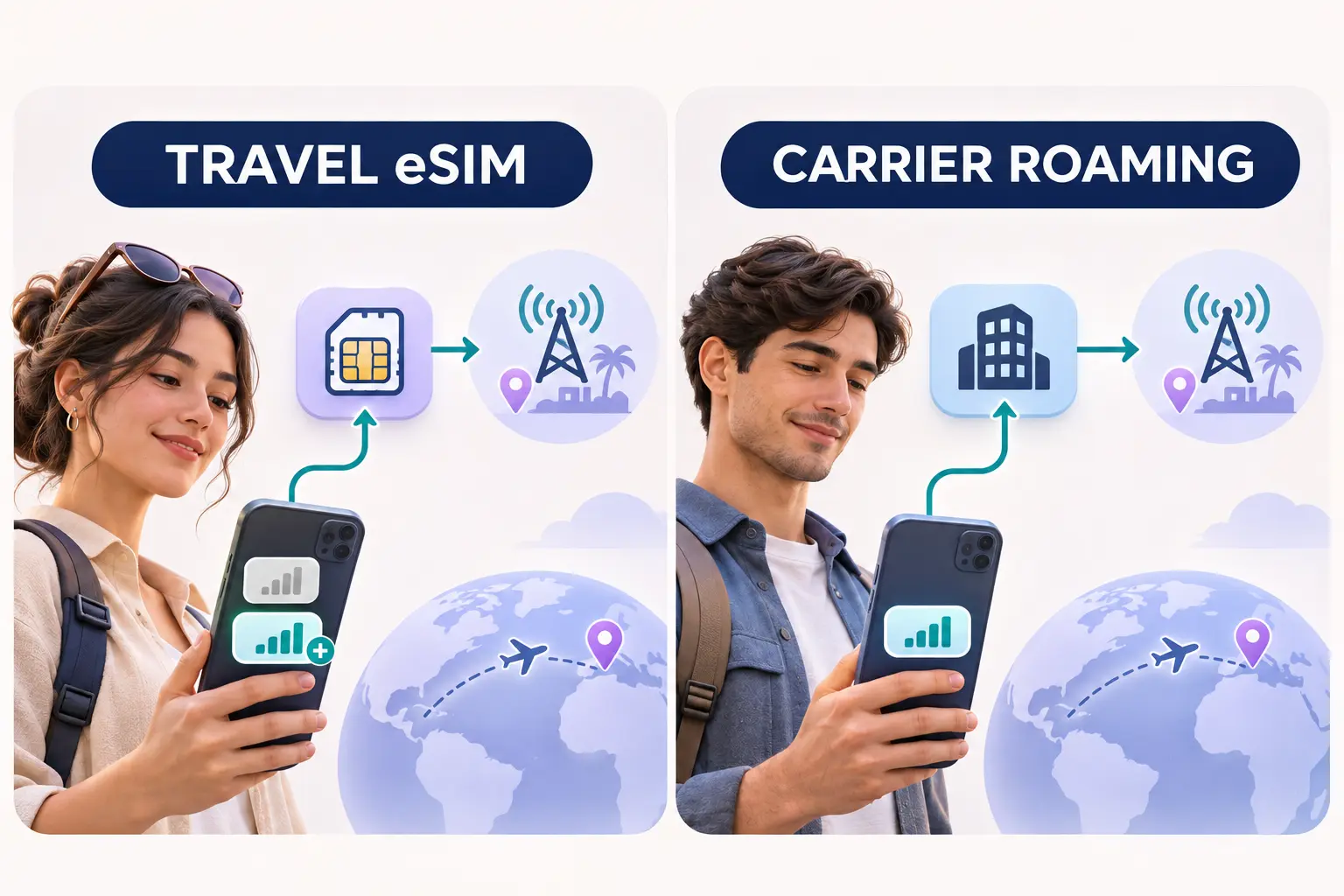
A travel eSIM and an international roaming plan are two ways to keep your phone connected while traveling overseas.
They can use the same local mobile networks, but the companies providing the service and the way you pay for it may differ.
How a travel eSIM works
An eSIM is a digital SIM profile that lets a compatible phone connect to a mobile network without inserting a physical SIM card.
A travel eSIM is a plan purchased for use in a particular country or region. It may come from a local mobile carrier or an international eSIM provider.
For example, you might purchase a prepaid travel eSIM that supplies 10 GB of data in Japan for a specified number of days.
You install the eSIM on your compatible phone and select it for mobile data when you arrive.
Some travel eSIMs include a local phone number and calling capabilities, but many international travel packages are data-only.
With a data-only plan, internet-based services such as maps, email, messaging, and supported voice-over-internet apps can work using mobile data.
Traditional cellular calling and SMS may still depend on your home line or another service.
According to Apple's international eSIM guidance, supported iPhones can use a travel eSIM alongside an existing line, provided the device and carrier conditions are satisfied.
How international roaming works
International roaming occurs when you use your existing mobile provider's service while connected to an overseas network.
For example, a traveler with a US mobile plan may connect to a participating network while visiting Japan.
The home provider manages the relationship with the overseas network and applies the roaming terms associated with the traveler's plan.
There are several common pricing arrangements:
- Roaming included within an existing monthly plan.
- A daily international travel pass.
- A fixed-duration international data or calling package.
- Pay-as-you-go charges for individual calls, texts, or data usage.
The cost depends on the provider, destination, and specific mobile plan.
An important distinction: International roaming can also operate through an eSIM. The real buying decision is typically between using your existing carrier abroad and purchasing a separate travel plan.
Travel eSIM vs roaming: Quick comparison
| Feature | Travel eSIM | Existing-carrier roaming |
|---|---|---|
| Provider | Local or international eSIM provider | Your current carrier |
| Phone compatibility | Requires eSIM support and appropriate device unlocking | Generally uses your existing eligible line |
| Pricing model | Often prepaid by data amount and validity period | Included allowance, daily pass, package, or usage charges |
| Calls and texts | Often data-only; varies by plan | Commonly retains home-number calling and texting features |
| Home phone number | Can remain available through a separate line, subject to settings and charges | Normally remains your primary number |
| Data allowances | Specific package limits and speed policies | Based on domestic-plan and roaming-pass terms |
| Setup | Installation and selection of another plan | Often automatic or activated through your carrier |
| Best fit | Travelers primarily needing data at a predictable cost | Travelers prioritizing home-number continuity and simplicity |
Neither option is universally faster, safer, or more reliable. Actual network quality depends on local coverage, network agreements, device capabilities, congestion, and the selected plan.
Travel eSIM vs Roaming: How Much Does Each Cost?
The most useful comparison involves a specific destination, trip length, and data requirement.
A one-day visit and a two-week vacation can produce very different results.
Example: Seven days in Japan
Consider a US traveler spending seven days in Japan who wants approximately 10 GB of mobile data.
The following prices were checked on November 5, 2026, using official provider pages.
| Option | Illustrative extra cost | What the traveler receives |
|---|---|---|
| Airalo Japan travel eSIM | $17 | 10 GB data, seven-day validity, data-only |
| Verizon TravelPass | $84 | Seven chargeable days at $12/day, with calls, texts, and plan-specific data conditions |
| AT&T International Day Pass | $84 | Seven chargeable days at $12/day on land, under eligible plan terms |
| T-Mobile 10-Day International Pass | $50 | Up to ten days, 15 GB high-speed data and included calling on eligible plans |
| Included carrier roaming | Potentially $0 additional | Only if the existing plan already covers the destination and intended usage |
These are illustrative plan charges for one eligible line, not a like-for-like service comparison. Taxes, existing monthly-plan fees, optional services, and unplanned home-line charges are excluded. Data amounts and calling benefits differ.
Official sources: Airalo Japan, Verizon TravelPass, AT&T International Day Pass, and T-Mobile International Passes.
In this example, the separate travel eSIM has the lowest listed purchase price among the paid options.
However, the comparison would change if the traveler needed normal calling on their US number, used much more than 10 GB of data, or already had sufficient roaming included.
Example: Fourteen days in Japan
A longer trip makes daily fees more significant.
| Option | Illustrative extra cost | Important condition |
|---|---|---|
| Airalo Japan travel eSIM | $17.50 | 10 GB across a 15-day package |
| Verizon TravelPass | $168 | Fourteen chargeable days at $12/day |
| AT&T International Day Pass | $120 | Fourteen chargeable land-use days within one monthly bill period, subject to its ten-daily-fee cap |
| T-Mobile 30-Day International Pass | $75 | A 30-day pass containing 30 GB high-speed data on eligible plans |
These are calculations from advertised plans, not prices observed in a real customer's bill.
For AT&T, the ten-daily-fee cap applies per line per monthly bill period. If the trip crosses a billing-period boundary, the total could differ.
For Verizon, the example assumes the traveler triggers TravelPass on all fourteen days.
For T-Mobile, the 30-day pass is shown because the advertised 10-day pass does not cover a continuous fourteen-day trip by itself.
The Airalo package covers a substantially smaller data allowance than some of the other options and does not provide the same calling benefits.
The useful conclusion: A data-only eSIM can provide considerable savings for certain travel patterns, but a cheaper data allowance is not automatically equivalent to a full roaming service.
A simple cost formula
Use the following calculation before purchasing:
Daily roaming pass cost = number of chargeable days × daily rate, subject to the provider's caps and conditions.
Travel eSIM cost = package price + required top-ups + any separate charges from the home line.
For example, a $12 daily pass used on seven chargeable days costs $84 before applicable additional charges.
A $17 data package used for the same trip costs $17 if it provides enough data and no other charges are triggered.
But if you need multiple eSIM top-ups, special calling arrangements, or continued paid use of your home number, include those costs in the comparison.
This is why comparing only the headline eSIM price can be misleading.
When Is a Travel eSIM the Better Choice?
A travel eSIM is often attractive when mobile data matters more than standard cellular calling.
You're traveling for more than a few days
Daily roaming charges can accumulate quickly over a week or longer.
A prepaid eSIM valid for the entire trip may give you a clearer spending limit.
However, check whether your carrier has an international monthly pass or an existing allowance that changes the calculation.
You mainly need maps, email, and messaging
If your normal activities are checking directions, booking transport, browsing websites, or using messaging apps, a data-only package may be enough.
Before buying, consider whether you use video calls, stream entertainment, or upload large files regularly.
Those activities can consume substantially more data.
You want to control spending
Prepaid data allowances can help you see how much service you're purchasing.
But "prepaid" does not guarantee there will be no other charges.
If your home SIM remains active, calls, messages, or data usage on that line may still trigger fees.
The new eSIM controls only the service supplied through that plan.
You're visiting several countries
Regional travel eSIM packages can cover multiple destinations under one plan.
For example, Airalo advertises regional European eSIM options rather than requiring a separate national package for every stop.
Check that every country on your itinerary is included. Coverage may differ between the European Union, United Kingdom, Switzerland, and other nearby destinations.
Also verify whether crossing a border changes the available network or speed.
You're working remotely while traveling
Remote workers often need dependable connectivity for email, meetings, authentication, and navigation.
A travel eSIM can serve as an alternative connection when accommodation or public Wi-Fi is unreliable.
However, confirm whether hotspot or tethering is allowed, how much high-speed data is included, and what happens after the allowance is exhausted.
For broader planning, Spread Thoughts also has a guide to building a remote technology career as a digital nomad, which discusses connectivity and other practical remote-work needs.
When Is International Roaming the Better Choice?
Roaming through your existing provider may be worth keeping when it offers meaningful convenience or is already included.
Your existing plan includes roaming
This is the most important check.
Some mobile plans include international data and texting in specified destinations.
If your existing allowance covers the trip, a separate travel eSIM might add complexity without delivering meaningful savings.
Check whether included data is high-speed, whether reduced-speed access continues after an allowance, and which countries are covered.
You need regular calls on your home number
A data-only travel eSIM may not support the conventional calls and SMS services you need.
A carrier roaming plan may be better if you regularly receive business calls or need to make calls through your existing phone number.
Some travelers keep their home line active while using a travel eSIM for data.
That arrangement can work, but charges on the home line must be understood and controlled.
Your phone cannot use another provider's eSIM
To purchase a separate carrier's eSIM, your phone must support the necessary eSIM functionality and generally must be unlocked.
For iPhone users, Apple describes checking the carrier-lock setting under Settings → General → About.
If your phone is locked to its existing carrier, a separate travel eSIM may not work.
Roaming on your current eligible line can then be the simpler choice.
You're taking a very short trip
For a one-day visit, the convenience of using an existing service may outweigh the cost difference.
A traveler may prefer to avoid setting up another plan, especially if their carrier offers a low-cost destination-specific option.
You need one provider to manage the connection
A carrier roaming pass may be easier to administer when you depend on a consistent account, line, and service relationship.
However, convenience is not the same as guaranteed network reliability.
Check actual destination coverage rather than assuming your home carrier's name guarantees stronger service abroad.
Hidden Costs and Limitations That Can Change the Decision
Some of the most important differences are easy to overlook.
Data-only plans and phone calls
Many travel eSIM packages do not include a traditional voice number.
You may still be able to use internet calling through supported apps, but that is different from receiving a regular mobile call on your existing number.
If you need banks, customers, or family members to contact your usual mobile number, plan how that will work.
Also consider how important accounts deliver verification codes. Do not assume every service can send codes through an internet messaging app.
Unexpected charges on the home SIM
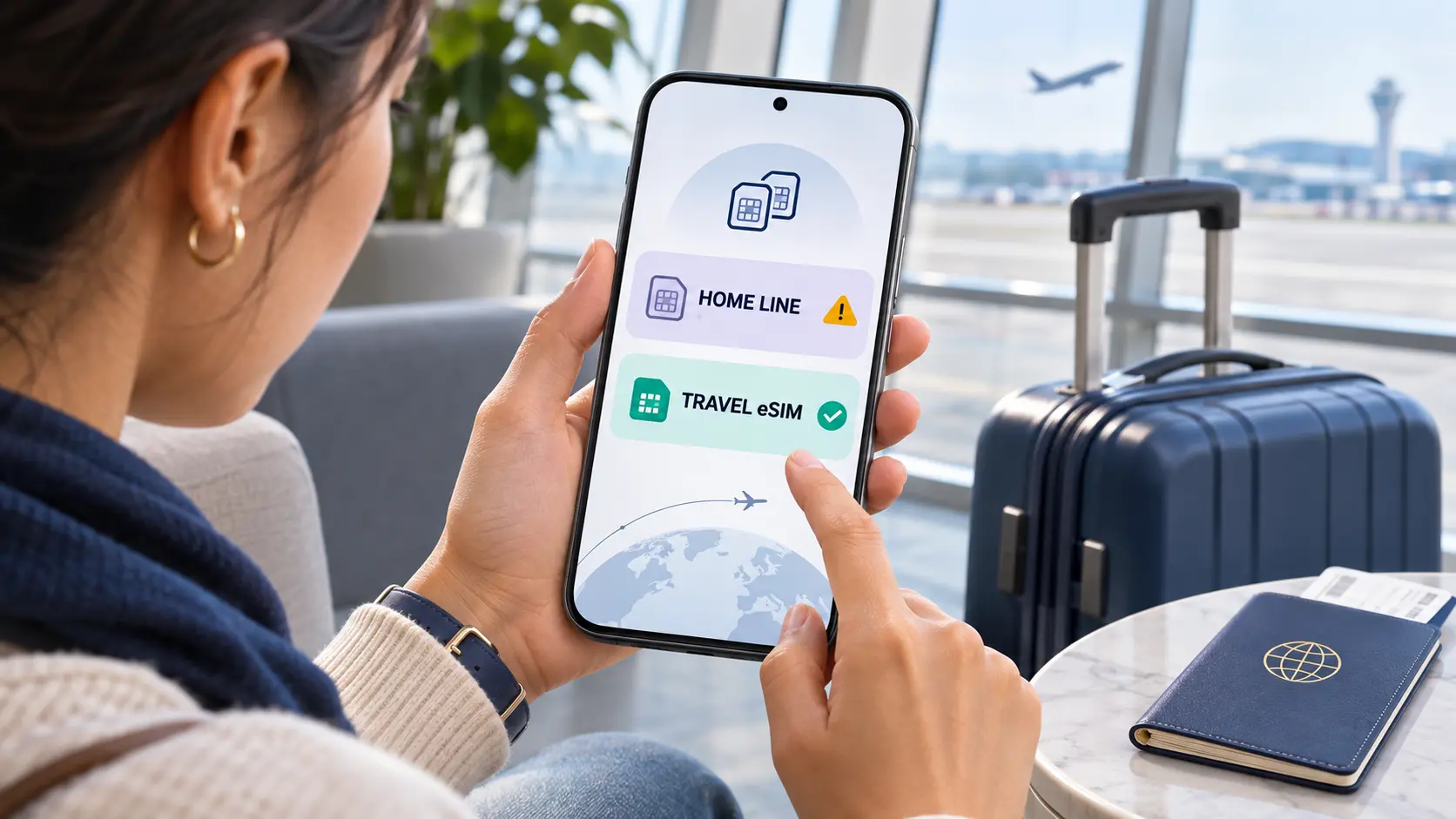
A dual-SIM phone can keep the home line available while using a travel eSIM for data.
However, a call, outgoing text, or unintended use of mobile data on the home line may trigger roaming charges.
Apple specifically warns that keeping both lines active can still result in roaming fees from the original carrier.
Before travel, review line-specific data selection, data switching, roaming settings, voicemail behavior, and the applicable charges.
"Unlimited" data restrictions
Unlimited packages can have speed-management or fair-use conditions.
Some plans allow a fixed amount of high-speed data and then provide reduced-speed access.
Others may limit hotspot use.
Compare the actual high-speed allowance, speed after the threshold, and validity period—not just the word "unlimited."
Activation and validity
A travel eSIM may have two important dates:
- The deadline for installing or activating the purchased plan.
- The date on which its usable validity period begins.
These do not necessarily start at the same time.
For example, Airalo's Japan plan documentation describes validity beginning when the eSIM connects to a supported network in its coverage area.
Other providers or plans may use different rules.
Read the specific package terms before buying far in advance.
Network and destination restrictions
An eSIM provider may use partner networks in each country.
Even if a country appears in the coverage list, network quality can differ between cities, rural regions, and indoor locations.
Check the supported networks and whether the data service is suitable for your planned activities.
Cruise ships and in-flight roaming
Ordinary travel eSIM coverage should not be assumed to include cellular services at sea or in the air.
Marine and airborne networks can have their own rates and eligibility rules.
For example, AT&T advertises a separate daily charge for eligible cruise-ship use rather than treating it as an ordinary land-based day.
If you're taking a cruise, check both the carrier's marine rules and your eSIM provider's coverage limitations.
What Should Travelers in the USA, UK, and Australia Know?
International connectivity pricing is not identical across countries.
The travelers' home networks, destinations, and applicable consumer rules can differ.
United States
US travelers should compare their existing carrier's international allowance with available travel eSIM packages.
Verizon, AT&T, and T-Mobile offer different daily rates, included benefits, and fixed-duration international options.
Do not assume that a plan advertised as international covers every destination or includes unrestricted high-speed data.
If you frequently visit Canada or Mexico, check your domestic plan first because some US plans already include benefits in those countries.
United Kingdom
UK travelers should confirm the roaming terms for their own mobile contract.
The UK's communications regulator, Ofcom, advises consumers to examine roaming charges and consider local SIM or eSIM alternatives.
A UK plan's EU roaming policy may differ from its charges for travel to the United States, Asia, or other destinations.
Do not assume European roaming is automatically free for every UK customer.
Australia
Australia's communications regulator, ACMA, advises travelers to check international roaming charges, monitor usage, and consider prepaid alternatives.
Australian carriers have specific obligations concerning roaming-price information and spending notifications.
Travelers should still check their plan's Critical Information Summary and the destination-specific rates before departure.
For international comparisons, prices should be viewed in the appropriate currency and under the relevant local terms. US-dollar examples in this guide are illustrative, not quotes for UK or Australian mobile accounts.
How to Choose Between a Travel eSIM and Roaming
Use this seven-step process to make a practical decision.
Step 1: Check your existing plan first
Find your provider's current international roaming page.
Confirm whether your destination is covered and whether any data, calls, or texting is included without an additional charge.
Step 2: Estimate how much data you need
Consider your actual usage.
Maps, messaging, browsing, and occasional email may require relatively modest amounts of data.
Frequent video calls, hotspot use, cloud transfers, and streaming may require much more.
If possible, review your normal cellular data usage on your phone before purchasing.
Step 3: Check device compatibility
Confirm that your phone supports eSIM and is not restricted to your existing carrier.
Check the travel provider's supported-device list rather than relying solely on the phone model's name.
Step 4: Compare total trip costs
Calculate what your home provider would charge for the expected number of use days.
Then compare travel eSIM packages with suitable validity periods and data allowances.
Include top-ups, required calling features, and potential charges on the original line.
Step 5: Verify destination coverage
Check the exact countries, partner networks, and important usage restrictions.
For multi-country trips, make sure a regional plan includes all your stops.
Step 6: Plan for your phone number
Decide whether you must retain ordinary incoming calls, send SMS, or receive verification messages on your home number.
If you keep both lines active, determine how to prevent unwanted roaming charges.
Step 7: Install and test carefully
Purchase through the official provider website or app.
Follow the installation instructions, protect the QR code or activation details, and verify which line is selected for data.
Avoid deleting your original line before you understand how to restore it.
If you encounter a problem, consult your carrier's official setup guidance before changing additional settings.
Frequently Asked Questions
1. Is a travel eSIM always cheaper than international roaming?
No. A separate travel eSIM may be cheaper than daily roaming fees, but some mobile plans already include international service. Calling needs, data usage, and destination-specific pricing can change the result.
2. Can I keep my regular phone number while using a travel eSIM?
Often, yes, on phones that support multiple active lines. You can use a travel eSIM for mobile data and retain your original line where supported. However, normal calls, texts, or data use on the home line may still create roaming charges.
3. Do travel eSIMs include phone calls and text messages?
Some do, but many travel eSIM plans offer data only. Check whether the package provides an actual phone number, conventional calling, SMS, or just internet access.
4. Can I install a travel eSIM before leaving home?
Often, yes. Many providers allow advance installation. However, check when the validity period starts and whether activation must occur within a certain time after purchase.
5. Will an eSIM work on a carrier-locked phone?
A separate travel provider's eSIM generally requires an unlocked device. Compatibility and carrier-lock requirements can vary, so verify both before purchasing.
6. Does using a travel eSIM prevent all roaming charges?
Not necessarily. A travel eSIM may let you avoid roaming data charges on the new plan, but your existing mobile line could still generate charges if it remains active and is used abroad.
7. Is a regional eSIM better for visiting multiple countries?
It can be convenient because one package may cover several destinations. Check the complete country list, validity, partner networks, and data allowances before choosing it over country-specific plans.
8. Which is better for a two-week international trip?
For a data-focused traveler, a travel eSIM can be good value, particularly when daily carrier fees would accumulate. If your existing plan includes suitable international roaming or you depend heavily on normal phone calls, your home carrier may be preferable.
Final Verdict: Travel eSIM or International Roaming?
A travel eSIM is often worth considering when you want predictable prepaid data costs for an overseas trip.
International roaming may be the better choice when it is already included in your mobile plan, you need the convenience of your existing phone number, or the trip is short enough that switching plans offers little benefit.
Before buying, compare the total cost for your specific destination, travel dates, data needs, and calling requirements.
The best travel connectivity choice is not the one advertising the lowest starting price. It's the one that provides the services you actually need without avoidable extra charges.


